Thursday, 30 April 2020

Out of the woods, pt 1

I have been getting into the woods a lot lately. Last year I started including trail running as part of my habit, and tackled my first big trail race, the 30km Coastal Classic, in September. It's an event that runs through the second oldest National Park in the world, the Royal National Park, although the beautiful old single track is being built out in most sections by fibreglass decking.


This isn't a completely new thing for me; I used to train for school cross country races by running around the farm paddocks and residual bushland of Jamberoo valley. I've even been running along the Mt Keira ring track, which we hiked around on Scout camps back in the nineties!


There's something about getting out into the woodlands and bush that makes trail running a different kind of experience. The natural world doesn't grow in the straight lines and even surfaces of our built environments; you must focus on each step, be aware of each tree and root and rock as you come across them. And the air just seems cleaner. Even during our summer of bushfire catastrophe, when the whole east coast of Australia was suffocating under smoke, getting out into the bush ringing the Illawarra provided some relief from the sense of doom. Every morning I woke up and surveyed the forested escarpment with trepidation, looking for a smoke plume that meant fire in our area, but I still felt like I could breathe easiest out amongst the peaceful gums.

That last part is why forests are a huge part of climate change - the ways plants breathe, drawing in carbon dioxide and releasing oxygen, is one of the key components of the carbon emissions equation. As it says in Drawdown: The Most Comprehensive Plan Ever Proposed To Reverse Global Warming, "no other mechanism known to humankind is as effective in addressing global warming as capturing carbon dioxide from the air through photosynthesis."

Increased carbon dioxide in the atmosphere has actually allowed plant productivity to increase, and the amount of carbon being drawn down by plants each year has gone up since 1960. As plants grow, they store carbon in their wood, and it is only released back into the atmosphere when it burns or rots:
Australian forests and wood products store or sequester approximately 57 million tonnes of carbon dioxide which offsets around 10% of the total greenhouse gases emitted in Australia. This takes into consideration a loss of carbon from forests each year of approximately 4.4 million tonnes due to prescribed burning, wildfires and wood harvested for energy. Carbon constitutes approximately 50% the dry mass of trees and when wood from these trees is used to produce wood products the carbon is stored for life in that product. For framing in our homes this carbon storage is life is around 100 years, around 30 years in furniture, 30 years in railroad ties and around 6 years in pallets and paper. Carbon stored in wood is only released back to the atmosphere when the wood product is burnt or decays.
At present, forests in Australia offset around 10% of our annual emissions (although keep in mind, carbon dioxide isn't the only greenhouse gas contributing to climate change).

Afforestation - the planting of trees in areas which have been treeless for at least fifty years - could soak up a lot of the excess carbon dioxide in the atmosphere. A study published in Science journal last year identified that "there is room for an extra 0.9 billion hectares of canopy cover, which could store 205 gigatonnes of carbon in areas that would naturally support woodlands and forests. This highlights global tree restoration as one of the most effective carbon drawdown solutions to date." It can be done cheaply, simply and within the timeframes that are projected to keep warming below 1.5c.

Good news about climate change - reforestation and afforestation can draw down a good chunk of all of humanity's historic greenhouse gas emissions and help undo the damage of anthropogenic climate change.

However, as the study identifies, that is not the trajectory we are on. We aren't getting into the woods: we are running out of them.


The World Wildlife Fund has identified the eastern coast of Australia as a global deforestation front - the only one in the developed world. The biggest part of the front has been in Queensland, where farmers have been given a free rein to clear land over the last decade. The amount of woodland Queensland cleared in 2015-16 alone was 395,000 hectares. The graphic comparison in this Guardian article, when centred on Mt Keira, stretches all the way from the start of the Royal National Park in the north, out to the bushfire-ravaged suburbs of Bargo and Yanderra, and south past Saddleback Mountain. Queensland's annual deforestation of native vegetation is an area bigger than the entire Illawarra region.


The world isn't afforesting or reforesting - it's deforesting. There is some dispute over how fast it is happening, and how much land that humans clear regenerates, but across the world, forests are disappearing. The Amazon, also the scene of a wildfire crisis in 2019, is being deforested at an accelerating rate.

Once again, there are market-based solutions in place to address the issue. Carbon credit schemes protect forests in the developing world by paying for trees not to be cut down and carbon to be stored, but, as with all market-based solutions, they simply pass the parcel on to another landowner or industry, offsetting the dirty work of pollution or deforestation that they do, rather than stopping it happening at all. And a carbon credit cannot prevent bushfires destroying the trees and releasing the carbon contained within them anyway. 

We are still going the wrong way.

We are running out of the woods. 

In part two, I go into what last summer's bushfires mean for carbon emissions, deforestation and climate change calculations.

Thursday, 23 April 2020

1.5°

The good news about climate change is that a lot of Australia's political spectrum agrees on a target of under 2°, and ideally under 1.5°, of warming.

What does this target mean? According to the Intergovernmental Panel on Climate Change, writing in 2018:
Climate models project robust7 differences in regional climate characteristics between present-day and global warming of 1.5°C,8 and between 1.5°C and 2°C.8 These differences include increases in: mean temperature in most land and ocean regions (high confidence), hot extremes in most inhabited regions (high confidence), heavy precipitation in several regions (medium confidence), and the probability of drought and precipitation deficits in some regions (medium confidence). {3.3}
If we keep to 1.5°, we have a chance of avoiding the kind of climate catastrophe that we haven't survived as a species since the Bronze Age. Many of the events that a 2° trajectory would bring could also trigger massive feedback loops; disruptive events in the global climate which themselves cause further global warming, such as ice sheet collapse or permafrost melting.

What would the difference mean for Australia? The end of this graphic model of temperature changes by the ABC gives a good illustration. With runaway climate change, the disastrous bushfire season we just experienced in Australia would be considered a relatively minor one. Our major cities will regularly experience 50° days in summer, and most of Australia will rapidly become unliveable.

If we keep to a 1.5° trajectory, warming, drying and intensification of extreme events should plateau, and we will have a chance to adapt our agriculture and living spaces to the new normal. It's not exactly good news, but bushfire seasons shouldn't get much worse than the one the east coast of Australia just had.

In this context, it's good news that many politicians, from Labor's Mark Butler to Zali Steggall's Climate Change Act to the Australian Greens, say we need to pursue efforts to limit warming to under 2°, and ideally, under 1.5°.

The bad news about climate change, though, is that all of them are lying.

The countdown clock which I embedded in my last post is another graphic model of climate change - this one from the Mercator Research Institute. It shows, at the present estimated rate of emissions, how long we have left until the world's carbon budgets for the 1.5° and 2° trajectories modelled by the IPCC are used up. If the world wants to keep to a 1.5° and was to keep emitting at the present rate (keeping in mind this hasn't been adjusted to account for the present pandemic), we will need to be emitting less greenhouse gases than the world can absorb some time in 2028.

Net zero in 8 years.

The earlier we start reducing emissions, the longer we can buy before we need to reach net zero. But climate change is primarily the responsibility of the global north; 20% of GHG emissions in the atmosphere originated from the USA, 17% from the EU, even though they only account for 4.29% and 9.78% of the world's population respectively. So it is our historic responsibility, as nations with the capital on hand because we were able to rapidly industrialise, to decarbonise first. This principle is called climate justice.

And even if you put the argument that our fair share is more than average aside, the political parties are still lying about the numbers. 

The Australian Greens come closest to matching the science; their policy is for net zero by "no later than 2040." This date doesn't match up to the remaining carbon budget for a 1.5° trajectory unless we make very deep cuts in the next few years and then tapers our reductions towards zero. Their policy mechanisms, of "strong regulatory intervention and a strong effective price on carbon", are not up to the job. The track record of carbon prices is that, like all other market mechanisms, they are good at making profit, but prone to spectacular failure and boom-and-bust cycles. These tools are not going to reduce emissions fast enough, even if the Australian Greens took government at the next election (some time before May 2022).

They might keep us within the 2° trajectory, for which the countdown clock runs out in 2045. Yet still the Greens policy states that Australia needs to "pursue efforts to limit the temperature increase to 1.5°C above pre-industrial levels". If they were serious about that goal, then their target for net zero would be much sooner than 2040, and they would not be allowing coal exports to continue for the rest of the decade.

The policies of Labor, and Zali Steggall's climate bill, are even more blatant lies. Both claim to support under 2°, and ideally 1.5°, of warming. Yet Labor has stated that it will not shut down any coal infrastructure or stop the Adani Carmichael mine, which will itself cancel out all pledged reductions in Australian emissions. It should be no surprise that both have a target of net zero emissions by 2050 - completely incompatible with the 1.5° target, even if Australia ignores the principle of climate justice. If this target allows for decades of coal exports, as Labor seems to think it does, then it rules us out of even keeping within 2° of warming. 

If Labor takes government at the next election with this policy, or if net zero by 2050 is written into law by the Climate Act, children born today will probably never experience a summer as "mild" as the devestating one we just had. If we start today, then the whole world needs to hit net zero by roughly 2040 to keep within 2° of warming; if we don't start until the next term of government, closer to 2035. A 2050 target guarantees runaway climate change.


The policy mechanisms we actually need to keep within a 1.5 carbon budget have been known and available for a long time. The Beyond Zero Emissions plan for Australia's stationary energy shows us that a massive expansion of concentrated solar thermal (CST) and wind power, along with improved connection of our grids all the way from east to west coast, could completely decarbonise our electricity grid within a decade. 

Since that plan was written in 2010, it has only grown more technologically viable - yet, when investment is left to the free market, even a single CST plant with massive support in its local community is struggling to get off the ground. We can't leave it up to the market. What is clearly needed is direct government investment in our energy infrastructure - politically and economically unthinkable in the era of privatisation, at least in this country.


But the rules of the neoliberal era have gone out the window in the face of the current pandemic. If we can find hundreds of billions of dollars on demand to boost welfare (and the profit margins of retail giants, private health insurers and landlords), and if we can nationalise hospitals overnight when there is a public health threat - then why can't we do the same to address the climate crisis that threatens to destroy our rural communities and, perhaps, the very existence of our civilization?


Tuesday, 21 April 2020

The Terminator Line

Since the world has been overtaken by a pandemic, I've been doing a lot of reading about climate change. I think, in a strange way, it's a good time for it. Firstly because, here in Australia at least, the issue exploded back into the headlines last year. The heads of our emergency services told us that climate change is the root cause of the most devestating bushfire season we've ever had. Following on the heels of the School Strike 4 Climate movement, the fires shifted the conversation out of the weeds of market mechanisms, to the need for bold action in line with the science.

Secondly, some of the bold actions we need to take, which seemed unthinkable in the era of neoliberalism, are suddenly on the table again - because of the pandemic. Air travel has been heavily restricted, economies have been deliberately shrunk for the sake of public health, the insecurity of a just-in-time global production and transport system has been been rubbed in our faces. And even more than all that, people are realising that the constant need for more - to work and stress our whole lives to forestall the fear that there won't be enough - is actually a social choice.

Meanwhile, the terminator line keeps approaching. Not the one I started writing about when I was travelling the world, the one that separates day from night; but the one that separates us from a liveable climate for humanity. There may be a blip in global emissions thanks to this pandemic, but if we don't use this opportunity to make radical changes, then the sun will keep setting on us.

Monday, 18 January 2016

Navigating Palestine: Christmas donations


Wednesday, 23 December 2015

30 olive trees

So far, since asking for donations for Palestine this Christmas, we've raised donations for 30 olive trees. A massive thankyou for everyone who has donated so far! Certificates have been emailed to all donors.


However, there's still a lot more to be done. We will be planting in the days after Christmas, as part of To Be There's Christmas tour program, as well as in February and March. The field we are working on after Christmas can be planted with 60 to 100 trees, so there's still plenty of room for more donations.

image courtesy of The Palestinian Olive

With the news of more attacks on Palestinian farmers in the West Bank, and the continuing death toll from extrajudicial killings by Israeli shooters, both military and civilians, our solidarity is more important than ever. Please donate! Get in touch via email if you are interested.


Palestine: Intensified boycott campaign responds to Israel's intensified repression

Originally published by Green Left Weekly, December 4.
 

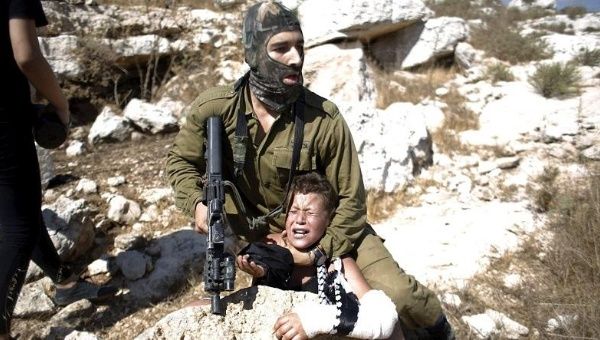
Israel has detained at least 1200 children since October 1.

As the latest upsurge in mass Palestinian resistance to Israel's occupation entered its third month, the world marked the International Day of Solidarity with the Palestinian People on November 29.

The date marks the UN's recognition of Palestine as a non-member observer state in 2012, as well as the adoption of the original UN partition plan in 1947, that divided Palestine into two states.

Governments and international bodies around the world took the opportunity to express solidarity with the Palestinian people. Yet there are no signs that the self-styled “international community” — in reality, the Western imperialist countries and their allies — are making the radical shift away from supporting Israel's crimes that true solidarity would entail.

The day before, the Palestinian Liberation Organisation (PLO) issued a damning statement announcing the number of Palestinians arrested by the occupying forces since October 1 had reached 2400 — half of them children under 18.

The death toll from the recent violence is 104 Palestinians, 21 Israelis, one American and one Eritrean, Al Jazeera reported on November 30.

The death of Palestinians have been obfuscated by Israel's propaganda machine, with victims slandered as "stone throwers" or "knife attackers".

Extrajudicial killings
An example of this was the murder of Ashraqat Taha Ahmad Qatanani, 16 years old, at Huwarra checkpoint on November 22. She was run over by a prominent Israeli settler, Gershon Mesika, whose car ran off the road after striking Qatanani.

He alleged, without any evidence, she was about to attempt a stabbing of Israelis waiting at the checkpoint's bus stop. “I didn't think twice: I stepped on the gas,” he told Arutz Sheva that day. Arutz Sheva dubbed Mesika a "hero civilian" who "thwarted a stabbing".

After Mesika ran her down, nearby soldiers shot the wounded teenager, who died at the scene.
Israeli Prime Minister Benjamin Netanyahu, who visited the US in November, took the opportunity to press Barack Obama's government to recognise the illegal settlements built on Palestinian land in the West Bank, Haaretz reported on November 24.

Internet access
Meanwhile, the Israeli government has finally allowed for West Bank Palestinians to access 3G mobile internet infrastructure, with an agreement signed by Israel's Army Coordinator Yoav Mordachai and Palestine's Minister for Civil Affairs Hussein al-Sheikh on November 19.

Mamoun Mattar, a Palestinian IT and broadcasting expert, told Al Jazeera on November 29: “I am not sure it is that advantageous now to go to 3G while all surrounding countries are using 4G and are preparing for 5G.”

He said Israel had only allowed the concession as they had already upgraded their network to 4G, leaving the frequencies vacant. However, communication will still be restricted — and Gazan Palestinians won't be granted access to 3G at all.

BDS backlash
The strongest international responses to the latest wave of oppression have been through the movement for Boycott, Divestment and Sanctions (BDS). Some important BDS campaigns have come to fruition.

The American Anthropological Association overwhelmingly voted to support boycotting Israeli academic institutions on November 20, joining a number of United States academic bodies which have supported the academic boycott in recent years.

Campaign group Anthropologists for the Boycott of Israeli Academic Institutions declared the victory “a historic day for the Association, affirming the finest anti-colonial, anti-racist traditions within the discipline of anthropology.”

And while it falls far short of full BDS against Israel, the European Union's decision to mandate all Israeli settlement goods be clearly labelled on November 11 poses a real threat to Israel's attempts to annex the West Bank by stealth through ever-expanding settlements.

Hysteria over BDS
The decision has resulted in hysteria in Israel, with Netanyahu responding that the decision “brings back dark memories”, alluding to the boycott of Jewish businesses during the 1930s. Other Israeli government ministers repeated the clichéd denunciations of “disguised anti-Semitism”.

Netanyahu even announced on November 29, International Day of Solidarity with the Palestinian People, that Israel would unilaterally suspend the European Union from peace talks between Israel and Palestine.

Hysteria over BDS has even led Israel's parliament, the Knesset, to pass the initial reading of a law that would “bar anyone who publicly calls to boycott Israel or part of Israel from entering the country.” Lawmaker MK Yinon Magal said, “Anyone who wants to boycott is welcome to do so from Syria.”

The Israeli hysteria over BDS, or even partial measures like the EU's settlement labelling decisions, is an indication that international solidarity with Palestine can be effective.

Israeli military companies have recently begun to feel the impact, with their exports last year falling to just 53% of their 2012 peak, prompting Israel's four biggest arms dealers to write a letter warning Netanyahu of a “major crisis”.

But the Australian subsidiary Israeli arms dealer Elbit, which was targeted by BDS protesters in 2014, hopes to kick-start their faltering exports with a new joint bid with Australian manufacturer Elphinstone Group to build 225 Sentinel II vehicles for the Australian Defence Forces (ADF).

This should be the focus of protests.

Tuesday, 8 December 2015

Occupied Palestine: How Israeli occupation trashes the environment

Originally published by Green Left Weekly, November 23


Ownership of the land of Palestine is hotly contested, so it is little surprise that the Earth itself is often the first casualty of Israel's occupation.

Israel uses a variety of tactics to try and drive Palestinians from their traditional lands and claim the spoils. This can mean direct violence against people, which includes settlers destroying the olive groves that Palestinian farmers have maintained for thousands of years.

But Israel also uses a scorched earth approach: contaminating arable land with garbage, draining aquifers of water and denying Palestinians the ability to develop sustainably.

Water
The apartheid practices of the state of Israel restrict day-to-day access to water for Palestinians. A 2013 report by Palestinian human rights organisation Al-Haq shows that water consumption by Israelis is around three to four times higher than that of Palestinians in the Occupied Territories.

Palestinian water consumption in the West Bank averages 73 litres per person per day, well below the World Health Organisation minimum of 100 litres, while Israelis use 300 litres on average. Israeli settlers consume even more — averaging 373 litres for personal use — while agricultural settlements in the Jordan Valley draw a whopping 1312 litres per capita.

“The level of unrestricted access to water enjoyed by those residing in Israel and Israeli settlers demonstrates that resources are plentiful and that the lack of sufficient water for Palestinians is a direct result of Israel's discriminatory policies in water management,” the report states.

The way Israel achieves this plentiful supply of water is through over-extraction from the Jordan River and the aquifers that lie underneath Israel, the West Bank, Gaza and the Sinai. Al-Haq reports that 38 Israeli wells are located in the West Bank, and Palestinians are denied access to waters of the Jordan River, despite it forming the eastern boundary of the West Bank under international law.

Friends of the Earth Middle East, a joint Israeli-Palestinian-Jordanian organisation, reports that, “Diversion of 96% of its fresh water, in addition to discharge of large quantities of untreated sewage, threatens to irreversibly damage the River Valley.”

Waste
Sewage dumping is not just a problem for the Jordan River Valley. Israeli settlements routinely release their waste water so as to contaminate Palestinian agricultural land, while landfill is often routinely dumped by Israeli companies on Palestinian land.

“Israel has been dumping waste, including hazardous and toxic waste, into the West Bank for years as a cheaper and easier alternative to processing it properly in Israel at appropriate hazardous waste management sites,” Palestinian Environmental Authority (PEA) deputy director Jamil Mtoor told Inter Press Service in 2009.

Attempts by Palestinians to establish any kind of waste recycling are routinely frustrated by Israel. Restrictions on construction outside of the densely populated Zones A & B of the West Bank — under full or partial control of the Palestinian Authority, respectively — are almost total.

Industries which are able to recycle waste have even been actively targeted by Israel. In 2005, Israel banned sulphuric acid from entering the West Bank due to “security concerns”. This has meant a recycling plant used by the tanning industry in Hebron for removal of chromium has been unable to function and Palestinian tanneries have been at risk of closure since, Middle East Monitor reported in February.

Agricultural resistance
There are a variety of ways in which Palestinians resist Israel's environmental degradation of their country. Permaculture offers a way to bring together issues of environmental degradation, food security and maintaining traditional culture.

“Permaculture as a technique is not a new thing for us as Palestinians,” Palestinian farmer Murad al-Khufash told Green Left Weekly. “Before the occupation, before the new technologies, chemical fertilisers, pesticides, etc, we used to live in the permacultural way. As a word it is new, but the lifestyle is old.”

Permaculture is an agricultural philosophy based on three principles: care for the Earth — allowing all life forms in the ecosystem to flourish; care for people — farming to provide for people's needs; and, taking a fair share — reinvesting the surplus back into the ecosystem, rather than the agribusiness logic of extracting as much value from the soil as possible.

Al-Khufash owns a permaculture farm in the village of Marda, nestled beneath the Israeli settlement of Ariel. Israeli human rights organisation B'tselem reported in 2010 that "prolonged neglect of treatment of Ariel's waste water" had already resulted in damage to the surrounding environment.

"We want to show people you can resist the occupation by having your own security, your own food," al-Khufash told GLW. "One day I'll have everything set up in the farm: milk, eggs, meats, vegetables, electricity, water — you don't need anything from outside. With the checkpoints closing the streets and cities isolated from each other, it's not easy to get from place to place, so that is a kind of resistance."