Showing posts with label settlers. Show all posts

Monday, 18 January 2016

Navigating Palestine: Christmas donations


Wednesday, 23 December 2015

Palestine: Intensified boycott campaign responds to Israel's intensified repression

Originally published by Green Left Weekly, December 4.
 

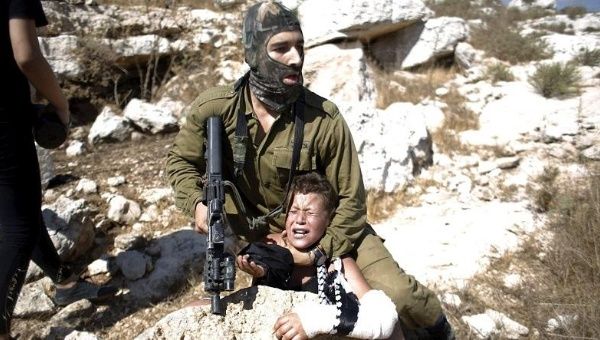
Israel has detained at least 1200 children since October 1.

As the latest upsurge in mass Palestinian resistance to Israel's occupation entered its third month, the world marked the International Day of Solidarity with the Palestinian People on November 29.

The date marks the UN's recognition of Palestine as a non-member observer state in 2012, as well as the adoption of the original UN partition plan in 1947, that divided Palestine into two states.

Governments and international bodies around the world took the opportunity to express solidarity with the Palestinian people. Yet there are no signs that the self-styled “international community” — in reality, the Western imperialist countries and their allies — are making the radical shift away from supporting Israel's crimes that true solidarity would entail.

The day before, the Palestinian Liberation Organisation (PLO) issued a damning statement announcing the number of Palestinians arrested by the occupying forces since October 1 had reached 2400 — half of them children under 18.

The death toll from the recent violence is 104 Palestinians, 21 Israelis, one American and one Eritrean, Al Jazeera reported on November 30.

The death of Palestinians have been obfuscated by Israel's propaganda machine, with victims slandered as "stone throwers" or "knife attackers".

Extrajudicial killings
An example of this was the murder of Ashraqat Taha Ahmad Qatanani, 16 years old, at Huwarra checkpoint on November 22. She was run over by a prominent Israeli settler, Gershon Mesika, whose car ran off the road after striking Qatanani.

He alleged, without any evidence, she was about to attempt a stabbing of Israelis waiting at the checkpoint's bus stop. “I didn't think twice: I stepped on the gas,” he told Arutz Sheva that day. Arutz Sheva dubbed Mesika a "hero civilian" who "thwarted a stabbing".

After Mesika ran her down, nearby soldiers shot the wounded teenager, who died at the scene.
Israeli Prime Minister Benjamin Netanyahu, who visited the US in November, took the opportunity to press Barack Obama's government to recognise the illegal settlements built on Palestinian land in the West Bank, Haaretz reported on November 24.

Internet access
Meanwhile, the Israeli government has finally allowed for West Bank Palestinians to access 3G mobile internet infrastructure, with an agreement signed by Israel's Army Coordinator Yoav Mordachai and Palestine's Minister for Civil Affairs Hussein al-Sheikh on November 19.

Mamoun Mattar, a Palestinian IT and broadcasting expert, told Al Jazeera on November 29: “I am not sure it is that advantageous now to go to 3G while all surrounding countries are using 4G and are preparing for 5G.”

He said Israel had only allowed the concession as they had already upgraded their network to 4G, leaving the frequencies vacant. However, communication will still be restricted — and Gazan Palestinians won't be granted access to 3G at all.

BDS backlash
The strongest international responses to the latest wave of oppression have been through the movement for Boycott, Divestment and Sanctions (BDS). Some important BDS campaigns have come to fruition.

The American Anthropological Association overwhelmingly voted to support boycotting Israeli academic institutions on November 20, joining a number of United States academic bodies which have supported the academic boycott in recent years.

Campaign group Anthropologists for the Boycott of Israeli Academic Institutions declared the victory “a historic day for the Association, affirming the finest anti-colonial, anti-racist traditions within the discipline of anthropology.”

And while it falls far short of full BDS against Israel, the European Union's decision to mandate all Israeli settlement goods be clearly labelled on November 11 poses a real threat to Israel's attempts to annex the West Bank by stealth through ever-expanding settlements.

Hysteria over BDS
The decision has resulted in hysteria in Israel, with Netanyahu responding that the decision “brings back dark memories”, alluding to the boycott of Jewish businesses during the 1930s. Other Israeli government ministers repeated the clichéd denunciations of “disguised anti-Semitism”.

Netanyahu even announced on November 29, International Day of Solidarity with the Palestinian People, that Israel would unilaterally suspend the European Union from peace talks between Israel and Palestine.

Hysteria over BDS has even led Israel's parliament, the Knesset, to pass the initial reading of a law that would “bar anyone who publicly calls to boycott Israel or part of Israel from entering the country.” Lawmaker MK Yinon Magal said, “Anyone who wants to boycott is welcome to do so from Syria.”

The Israeli hysteria over BDS, or even partial measures like the EU's settlement labelling decisions, is an indication that international solidarity with Palestine can be effective.

Israeli military companies have recently begun to feel the impact, with their exports last year falling to just 53% of their 2012 peak, prompting Israel's four biggest arms dealers to write a letter warning Netanyahu of a “major crisis”.

But the Australian subsidiary Israeli arms dealer Elbit, which was targeted by BDS protesters in 2014, hopes to kick-start their faltering exports with a new joint bid with Australian manufacturer Elphinstone Group to build 225 Sentinel II vehicles for the Australian Defence Forces (ADF).

This should be the focus of protests.

Tuesday, 8 December 2015

Occupied Palestine: How Israeli occupation trashes the environment

Originally published by Green Left Weekly, November 23


Ownership of the land of Palestine is hotly contested, so it is little surprise that the Earth itself is often the first casualty of Israel's occupation.

Israel uses a variety of tactics to try and drive Palestinians from their traditional lands and claim the spoils. This can mean direct violence against people, which includes settlers destroying the olive groves that Palestinian farmers have maintained for thousands of years.

But Israel also uses a scorched earth approach: contaminating arable land with garbage, draining aquifers of water and denying Palestinians the ability to develop sustainably.

Water
The apartheid practices of the state of Israel restrict day-to-day access to water for Palestinians. A 2013 report by Palestinian human rights organisation Al-Haq shows that water consumption by Israelis is around three to four times higher than that of Palestinians in the Occupied Territories.

Palestinian water consumption in the West Bank averages 73 litres per person per day, well below the World Health Organisation minimum of 100 litres, while Israelis use 300 litres on average. Israeli settlers consume even more — averaging 373 litres for personal use — while agricultural settlements in the Jordan Valley draw a whopping 1312 litres per capita.

“The level of unrestricted access to water enjoyed by those residing in Israel and Israeli settlers demonstrates that resources are plentiful and that the lack of sufficient water for Palestinians is a direct result of Israel's discriminatory policies in water management,” the report states.

The way Israel achieves this plentiful supply of water is through over-extraction from the Jordan River and the aquifers that lie underneath Israel, the West Bank, Gaza and the Sinai. Al-Haq reports that 38 Israeli wells are located in the West Bank, and Palestinians are denied access to waters of the Jordan River, despite it forming the eastern boundary of the West Bank under international law.

Friends of the Earth Middle East, a joint Israeli-Palestinian-Jordanian organisation, reports that, “Diversion of 96% of its fresh water, in addition to discharge of large quantities of untreated sewage, threatens to irreversibly damage the River Valley.”

Waste
Sewage dumping is not just a problem for the Jordan River Valley. Israeli settlements routinely release their waste water so as to contaminate Palestinian agricultural land, while landfill is often routinely dumped by Israeli companies on Palestinian land.

“Israel has been dumping waste, including hazardous and toxic waste, into the West Bank for years as a cheaper and easier alternative to processing it properly in Israel at appropriate hazardous waste management sites,” Palestinian Environmental Authority (PEA) deputy director Jamil Mtoor told Inter Press Service in 2009.

Attempts by Palestinians to establish any kind of waste recycling are routinely frustrated by Israel. Restrictions on construction outside of the densely populated Zones A & B of the West Bank — under full or partial control of the Palestinian Authority, respectively — are almost total.

Industries which are able to recycle waste have even been actively targeted by Israel. In 2005, Israel banned sulphuric acid from entering the West Bank due to “security concerns”. This has meant a recycling plant used by the tanning industry in Hebron for removal of chromium has been unable to function and Palestinian tanneries have been at risk of closure since, Middle East Monitor reported in February.

Agricultural resistance
There are a variety of ways in which Palestinians resist Israel's environmental degradation of their country. Permaculture offers a way to bring together issues of environmental degradation, food security and maintaining traditional culture.

“Permaculture as a technique is not a new thing for us as Palestinians,” Palestinian farmer Murad al-Khufash told Green Left Weekly. “Before the occupation, before the new technologies, chemical fertilisers, pesticides, etc, we used to live in the permacultural way. As a word it is new, but the lifestyle is old.”

Permaculture is an agricultural philosophy based on three principles: care for the Earth — allowing all life forms in the ecosystem to flourish; care for people — farming to provide for people's needs; and, taking a fair share — reinvesting the surplus back into the ecosystem, rather than the agribusiness logic of extracting as much value from the soil as possible.

Al-Khufash owns a permaculture farm in the village of Marda, nestled beneath the Israeli settlement of Ariel. Israeli human rights organisation B'tselem reported in 2010 that "prolonged neglect of treatment of Ariel's waste water" had already resulted in damage to the surrounding environment.

"We want to show people you can resist the occupation by having your own security, your own food," al-Khufash told GLW. "One day I'll have everything set up in the farm: milk, eggs, meats, vegetables, electricity, water — you don't need anything from outside. With the checkpoints closing the streets and cities isolated from each other, it's not easy to get from place to place, so that is a kind of resistance."

Tuesday, 25 February 2014

SodaStream boycott gathers momentum

Originally published at Green Left Weekly.

The movement for boycott, divestment and sanctions (BDS) against Israel has captured headlines around the world after actress Scarlett Johansson signed a promotion deal with Israeli company SodaStream.

Johansson signed the deal to become SodaStream's first “global brand ambassador” on January 1. A Super Bowl halftime commercial starring the actress airing on February 2.

However, the deal resulted in an instant furore due to the company's use of an Israeli occupied industrial settlement zone in Palestinian West Bank to make their home soda machines.

Oxfam, who Johansson has represented as a “global ambassador” for eight years, released a statement one week after the deal with SodaStream was signed, declaring that “businesses that operate in settlements further the ongoing poverty and denial of rights of the Palestinian communities that we work to support”.

“Oxfam is opposed to all trade from Israeli settlements, which are illegal under international law,” it said.

The international aid group announced on January 30 that it had accepted Johansson's resignation as ambassador, as her deal with SodaStream was “incompatible” with her duties.

In 2009, actress and Oxfam ambassador Kristin Davis signed a deal with Ahava, a cosmetics company that also makes its products in West Bank settlements. Oxfam condemned the deal, but did not formally sever its relationship with Davis ― making Johansson's resignation a first.

SodaStream claims to be an ethical product, with a byline of “set the bubbles free”.

On its website, SodaStream boasts that it is an “'Active Green' solution that minimises the huge eco-footprint caused by the manufacture, transport and waste of plastic bottles.”

The company's ethics, however, have not stopped it running a plant in the Mishor Adumim industrial settlement zone. It was built in 1996 on stolen Palestinian land in the West Bank adjoining the large residential settlement of Ma'ale Adumim.

Of the factory's 1300 workers, 950 are Palestinian ― 500 from the West Bank and 450 with Israeli citizenship.

Johansson has endorsed the company's decision to operate there as a way of “building a bridge to peace between Israel and Palestine, supporting neighbours working alongside each other, receiving equal pay, equal benefits and equal rights”.

But this line of argument ignores that the West Bank workers are unable to speak out for fear of having their work permits revoked by the company. It also bypasses the questions of land ownership and self-determination inherent in any discussion of the settlements.

Alun McDonald, an Oxfam spokesperson on Israel and the occupied West Bank, told IBTimes.com that “the problem at the moment is it’s in an illegal settlement on occupied land”.

“If it’s an Israeli factory in a future Palestinian state, paying tax in Palestine and genuinely benefiting the economy, then it could be a good thing,” McDonald said. “Our opposition is not that it’s an Israeli company ― our position is the same for any company from any country working in settlements.”

A 2011 Who Profits report into the operations identified that the factory's municipal taxes go to the Ma'ale Adumim settlement Municipality, funding the growth of the settlement.

Who Profits quoted a 2000 interview with SodaStream founder Peter Wiseburgh stating that the decision to set up the plant was “not a political act”, but made because of the settlement's cheap rent and lax bureaucratic regulations.

The report also said the settlement block is strategically located on the eastern outskirts of Jerusalem, creating a barrier between the Palestinian cities of Bethlehem and Ramallah, south and north of Jerusalem. The settlement and surrounding apartheid wall actively prevent economic activity or freedom of movement between the north and south of the West Bank.

The settlements are the front line of Israel's continued colonisation of Palestinian lands. More than 1000 Palestinian Bedouins were forcibly relocated so that Johansson's “bridge to peace” in the settlement block could be built.

In many ways, SodaStream's bid to downplay or nullify the controversy reflects the growing strength of the BDS movement.

Campaigners have been delighted to see the company suffer, with share values plummeting on the back of worse than forecasted earnings, and Johansson's Super Bowl ad being poorly received.

But the news has been overshadowed by Israel issuing final approval of 558 new settlements in East Jerusalem on February 5.

Further Israeli colonisation of Palestine, and the need for BDS to counter it, is only growing more urgent.

Monday, 10 February 2014

Australia changes position on Israeli settlements

Originally published in Green Left Weekly.

The Abbott government has sunk to a new diplomatic low, with Foreign Minister Julie Bishop suggesting Israeli settlements should not be considered illegal.

Bishop made the comments during a visit to Israel. In a January 15 interview with the Times of Israel, she argued “the issue of settlements is absolutely and utterly fundamental to the negotiations that are under way and I think it’s appropriate that we give those negotiations every chance of succeeding”.

When asked if Israeli settlements inside Palestinian territory should be considered illegal, she replied: "I would like to see which international law has declared them illegal.”

If Bishop were interested in an answer, she would have to look no further than the 49th article of the Geneva convention, which says: "[An] Occupying Power shall not deport or transfer parts of its own civilian population into the territory it occupies”.

The International Court of Justice ruled in 2004 that the convention does apply to the West Bank — occupied by Israel during the 1967 war — and that settlement building and the construction of the apartheid wall that protects the settlements are in violation of the convention.

The Obama administration reaffirmed in November they "do not accept the legitimacy of continued settlement activity" after negotiations between the Palestinian Authority and the Israeli government broke down.

However, the truth is Israel's allies, such as Australia and the US, have never exerted any real pressure to stop the expansion of settlements or insist on their removal from Palestinian territory in the West Bank.

The US continues to guarantee Israel's "qualitative military edge" over its neighbours. A 2007 memorandum of understanding guarantees $30 billion of military aid over 10 years.

Since the election of Tony Abbott’s government, Australia's pretence of diplomatic neutrality on the issue has been shed in favour of bold-faced support for Israel. As negotiations were breaking down, Australia abstained from a UN resolution calling on Israel to "stop all settlement activities”.

But global pressure on the apartheid state is growing, despite the blind eye turned by Western governments to the crimes and atrocities committed by Israel.

The latest wave of activism has targeted actress Scarlett Johansson for becoming the new face of Israeli company SodaStream, which makes its products in the settlement of Ma'ale Adumim.

In a recent interview with Channel 2, Israel's Minister of Justice ,Tzipi Livni, said Israel was facing "South-Africa style isolation" due to the settlements, and that they were "bricks in the wall of isolation around us”.

It is a position in stark contrast to that of Bishop, who said in the Times of Israel that the boycott, divestment and sanctions (BDS) movement is “anti-Semitic”.

She said: “It identifies Israel out of all other nations as being worthy of a boycott, divestment and sanctions campaign? Hypocritical beyond belief.”

Her comments were criticised by the Australian Jewish Democratic Society, which said: "It is time for Australia to speak plainly to Israel about the urgent need to end the settlements, eliminate settler violence and set in place an internationally-supported process that results in withdrawal from the territories and a final resolution of the conflict.”

Bishop's comments have brought Australia's unilateral support for Israeli settlements back into the media. But the movement for BDS is not concerned only with settlements or settler violence.

The three fundamental demands of the BDS movement are for ending the occupation of the West Bank and Gaza and dismantling the apartheid wall; recognising the right of Palestinian citizens of Israel to full equality; and respecting the right of return of Palestinian refugees abroad.

The movement stands for justice for all Palestinians — those exiled or assimilated by Israel as well as those in the West Bank. That is what makes BDS so threatening and terrifying to apologists for Israeli apartheid like Bishop.

Thursday, 26 September 2013

When the wizard gets to me, I'm asking for a smaller heart

As a huge fan, I'm really disappointed to hear that, despite looking at the situation closely, Amanda Palmer has decided to cross the picket line of the Palestinian call for a cultural boycott of Israel and organise a gig in Tel Aviv.

I first came across Amanda Palmer around 2007; I was playing in a band with a couple of schoolfriends, and one of them suggested we play Coin Operated Boy. We weren't particularly good, but it was fun, and I borrowed the Dresden Dolls' whole discography at the time to listen to. 

Track forward a few years, and, after buying tickets to the gig when it was supposed to be in February, I had the honour for the first time of rocking out with AMANDA FUCKING PALMER live for myself earlier this month. It was at my partner's insistence that we got the tickets; she also backed the AFP kickstarter.


The stories of friends who had attended concerts left me with high expectations for the show; even so I was blown away. It was truly one of the most amazing gigs of my life. Although there was no crowd surfing pashes for me or my friends, at one point during 'Do It With A Rockstar' she did thrust the microphone into my mouth. I nearly fainted!


But I'd never be able to appreciate her music in the same way if she goes ahead with this gig. Simply taking a tour with Breaking the Silence, which she's cited as the reason she tipped to booking a gig, doesn't neutralise performing a public show in an apartheid state.

I hope Amanda (or anyone reading this) have read the PACBI website - if you haven't, you should really consider some of the arguments rebutting common reasons to break the boycott put here. Particularly worth reading in this context:

2. Why Not Boycott Other Human Rights Offenders Too?

...Israel is today the only state practicing a three-tiered system of oppression – occupation, colonization and apartheid – while being treated by Western states as part of their “democratic club” and, consequently, receiving unlimited political, economic, diplomatic, academic and cultural support from them. This entrenched and persistent Western complicity is precisely what perpetuates Israel’s colonial oppression and makes it a moral obligation for citizens of the West to endeavor to end their states’ respective complicity in Israel’s crimes. Striving to end collusion in human rights violations should be the absolute minimum that we expect from any conscientious artist or cultural worker.

I think AFP should go to Tel Aviv, and play for the kickstarter obligations. And I think she should take the tour with Breaking the Silence too. Visit the old city of Hebron, where a few hundred settlers terrorise the 10,000 Palestinian inhabitants in an attempt to ethnically cleanse the areas around the Ibrahim Mosque/Tomb of the Patriarchs. Visit Nablus, go through checkpoints where Palestinians are routinely denied entry while settlers are allowed to drive right though. Visit Bethlehem's 300 checkpoint at 4am, when Palestinian workers from the territories have to line up to try and get into Israel to start their jobs at 8am. If she is like me, then seeing these things for herself will break her heart and fill her with rage. If not, then I can respect that. Nonetheless, as someone who is totally on the right side of politics and who put on a 'Fuck Tony Abbott' T-shirt proferred by a fan during the signing after the gig, simply having that experience, documenting it, and sharing it with her fans will be a powerful thing.

But to play a public gig in Israel is to cross the picket line and say - this isn't cultural and religious apartheid, just another country with a few problems. And I would lose a lot of respect for Amanda Palmer and her amazing, challenging, uncompromising body of work if she does that.

Saturday, 1 June 2013

HAIM: Please don't perform in Israel!

I'm probably what is called an active promoter in marketing speak. Anyone who has spent much time with me had probably heard about my love for Nando's chicken, ASICS footwear, Sydney FC, or various video games. Perhaps this is contradictory for a radical like me, but life is contradiction...

This is also the case when it comes to bands and musicians. I spend almost as much time on social media sharing videos or snatches of lyrics as I do my politics.

When I first heard HAIM songs playing on the radio, I was hooked straight away on their soaring, rhythmitic vocals and funk-folk-pop fused guitars which got more entrancing with each listen. I started sharing away with Falling.


Then, trawling through Wikipedia I discovered the band - three sisters, Danielle, Este and Alana Haim - have an Israeli father. A thought occured. And a quick google came up with the headline "We want to perform in Israel."

It would be completely inconsistent for me to not boycott a band's music once they've gone to perform in Israel, given my campaigning for BDS.

This was hard for me to do with Cut Copy, when I liked a couple of their singles after they got airtime on triple J; they refused to follow the lead of artists who respected the call like Carlos Santana, Massive Attack and Gil-Scott Heron and performed their concert in Israel on June 23, 2011.

Until I found this out I was going to go on a massive fan-boy bender of love for Haim, in a way that I haven't since first discovering the Jezabels when their first EP was just out in 2009.

Now, if I let myself do that I will only be setting myself up to have to boycott a favourite band whenever their wish to perform in Israel comes true.

The call for international artists to boycott Israel is part of a specific global campaign, called by Palestinians and following the example of South Africa. It's not just a question of the personal politics of the artists, but the concrete actions and their political ramifications.

The politics of BDS are certainly up for debate and there's no one Palestinian or international perspective on going about it, but for me, I don't want to pick and choose which parts I think are effective. Palestinian civil society has, for the first time since the 1980s, come together in a united way to try and rebuild their national movement behind the demands of BDS: tearing down the apartheid Wall in the West Bank; allowing the right of return for the refugees of 1948, 1967 and after; full legal equality for Palestinian (and all other) citizens of Israel.

And until the state of Israel implements those demands, all of which have been repeatedly called for by international legal bodies and the UN, then it deserves to be boycotted.

Alice Walker this week released an open letter calling on Alicia Keys to cancel her performance:

It would grieve me to know you are putting yourself in danger (soul danger) by performing in an apartheid country that is being boycotted by many global conscious artists. You were not born when we, your elders who love you, boycotted institutions in the US South to end an American apartheid less lethal than Israel’s against the Palestinian people. Google Montgomery Bus Boycott, if you don’t know about this civil rights history already. We changed our country fundamentally and the various boycotts of Israeli institutions and products will do the same there....

Under a campaign named ‘Brand Israel’, Israeli officials have stated specifically their intent to downplay the Palestinian conflict by using culture and arts to showcase Israel as a modern, welcoming place...

Walker puts the case far more convincingly than I could. International artists performing in Israel is one part of a strategy of "re-legitimisation" for Israel, after the damage done by widespread media coverage of recent atrocities like the attacks on Lebanon and Gaza in 2006 and 2009/10, the assault on the Mavi Marmara, the arbitrary detention of Palestinian footballers...

A counter argument was put to me through a friend on Facebook when I discovered HAIM's position:

But maybe consistency is impossible when not everything or everyone is so black and white, good and bad, right and wrong. Maybe you are allowed to like someone's art, even if you don't agree with 100% of their politics. Especially if their art isn't about their politics

Is it right to boycott a band for their opinions alone? They haven't yet booked a date, merely answered questions put to them by the Israeli press. This hardly falls under the guidelines of PACBI's call for boycott of artists, which is mostly focused on either cultural projects with connections with Israeli institutions, or calling on international artists who have booked dates in Israel to respect the boycott and cancel those events.

To me, the fact that the Israeli press is interested in talking to the sisters reflects the political dimension of their comments; at a time when public figures like Dustin Hoffman, Arundhati Roy and Steven Hawking are boycotting Israel, their comments are held up as a counter to BDS.

So when young international artists, Jewish or otherwise, state in the media they dream of performing in Israel and don't mention the context of the BDS campaign calling on artists not to, they are engaging in politics and sending a signal that the situation in Israel in Palestine is "normal" - and they should expect a political response.

But HAIM has the right to their opinions. Many people, probably including artists, writers and actors I like, have politics I disagree with. That doesn't stop me listening to their music, so it won't stop me with HAIM.

"Baby Haim" Alana did an interview with online magazine of young Jewish Americans "Jewcy", in which she spoke about visiting Israel:
 
We have to go to Israel for the occasional family wedding. There are some crazy Israeli weddings! I love Israel; I think it’s such a beautiful place. A lot of people think ‘Oh you go to Israel because you’re Jewish.’ I encourage my friends who aren’t Jewish to go to Israel because it’s such a beautiful place, and it’s such an important place. There’s so much history there, and it doesn’t matter what religion you are. I’ve always felt like a deep connection to the country. Especially living in LA, we don’t really have any history. Our history starts with Hollywood.

As individuals, the sisters have their own stories and histories, which I don't think it's my place to comment on. I too felt the weight of history when I visited Jerusalem, Bethlehem, Nablus, Jaffa; the history of these places echoes throughout western cultures. I would also encourage everyone to visit Israel & the Occupied Territories and see life there for themselves, as I did, and form their own opinions.

But for HAIM to perform in Israel sends an altogether different message; it's to take a side in that history, to give support to the settlers burning Palestinian crops, to sick children being refused access to a pool because they are Bedouin, to the policies of the current Israeli government.

So I'm not boycotting HAIM or calling on others to do so, since they haven't actually done anything for them to be boycotted yet. But my respect for BDS means I will have to boycott their music if they ever do fulfil that dream 

As someone who would love to be an active promoter, I'm calling on HAIM to take another look at what's really happening in Israel and Palestine and make a statement that they will respect the boycott call. Hopefully it won't be long before Apartheid is ended in Israel and all citizens of the region, regardless of race or religion, will be given their rights.

You are performing today, alongside some of my other favourite artists, at the "Sound of Change" concert to promote women's empowerment. That sends a fantastic signal to the world, that public profile can be used to promote change. To refuse to perform in Israel - or better still, to perform in Gaza, as Alice Walker called on Alicia Keys to do - will send a signal that people of all races, religions and backgrounds want justice in Palestine.