Showing posts with label violence. Show all posts

Wednesday, 23 December 2015

Palestine: Intensified boycott campaign responds to Israel's intensified repression

Originally published by Green Left Weekly, December 4.
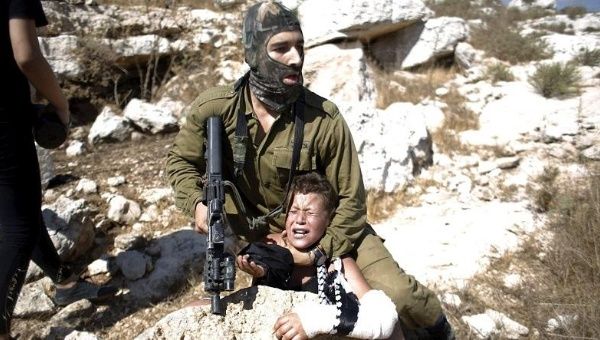
 

Israel has detained at least 1200 children since October 1.

As the latest upsurge in mass Palestinian resistance to Israel's occupation entered its third month, the world marked the International Day of Solidarity with the Palestinian People on November 29.

The date marks the UN's recognition of Palestine as a non-member observer state in 2012, as well as the adoption of the original UN partition plan in 1947, that divided Palestine into two states.

Governments and international bodies around the world took the opportunity to express solidarity with the Palestinian people. Yet there are no signs that the self-styled “international community” — in reality, the Western imperialist countries and their allies — are making the radical shift away from supporting Israel's crimes that true solidarity would entail.

The day before, the Palestinian Liberation Organisation (PLO) issued a damning statement announcing the number of Palestinians arrested by the occupying forces since October 1 had reached 2400 — half of them children under 18.

The death toll from the recent violence is 104 Palestinians, 21 Israelis, one American and one Eritrean, Al Jazeera reported on November 30.

The death of Palestinians have been obfuscated by Israel's propaganda machine, with victims slandered as "stone throwers" or "knife attackers".

Extrajudicial killings
An example of this was the murder of Ashraqat Taha Ahmad Qatanani, 16 years old, at Huwarra checkpoint on November 22. She was run over by a prominent Israeli settler, Gershon Mesika, whose car ran off the road after striking Qatanani.

He alleged, without any evidence, she was about to attempt a stabbing of Israelis waiting at the checkpoint's bus stop. “I didn't think twice: I stepped on the gas,” he told Arutz Sheva that day. Arutz Sheva dubbed Mesika a "hero civilian" who "thwarted a stabbing".

After Mesika ran her down, nearby soldiers shot the wounded teenager, who died at the scene.
Israeli Prime Minister Benjamin Netanyahu, who visited the US in November, took the opportunity to press Barack Obama's government to recognise the illegal settlements built on Palestinian land in the West Bank, Haaretz reported on November 24.

Internet access
Meanwhile, the Israeli government has finally allowed for West Bank Palestinians to access 3G mobile internet infrastructure, with an agreement signed by Israel's Army Coordinator Yoav Mordachai and Palestine's Minister for Civil Affairs Hussein al-Sheikh on November 19.

Mamoun Mattar, a Palestinian IT and broadcasting expert, told Al Jazeera on November 29: “I am not sure it is that advantageous now to go to 3G while all surrounding countries are using 4G and are preparing for 5G.”

He said Israel had only allowed the concession as they had already upgraded their network to 4G, leaving the frequencies vacant. However, communication will still be restricted — and Gazan Palestinians won't be granted access to 3G at all.

BDS backlash
The strongest international responses to the latest wave of oppression have been through the movement for Boycott, Divestment and Sanctions (BDS). Some important BDS campaigns have come to fruition.

The American Anthropological Association overwhelmingly voted to support boycotting Israeli academic institutions on November 20, joining a number of United States academic bodies which have supported the academic boycott in recent years.

Campaign group Anthropologists for the Boycott of Israeli Academic Institutions declared the victory “a historic day for the Association, affirming the finest anti-colonial, anti-racist traditions within the discipline of anthropology.”

And while it falls far short of full BDS against Israel, the European Union's decision to mandate all Israeli settlement goods be clearly labelled on November 11 poses a real threat to Israel's attempts to annex the West Bank by stealth through ever-expanding settlements.

Hysteria over BDS
The decision has resulted in hysteria in Israel, with Netanyahu responding that the decision “brings back dark memories”, alluding to the boycott of Jewish businesses during the 1930s. Other Israeli government ministers repeated the clichéd denunciations of “disguised anti-Semitism”.

Netanyahu even announced on November 29, International Day of Solidarity with the Palestinian People, that Israel would unilaterally suspend the European Union from peace talks between Israel and Palestine.

Hysteria over BDS has even led Israel's parliament, the Knesset, to pass the initial reading of a law that would “bar anyone who publicly calls to boycott Israel or part of Israel from entering the country.” Lawmaker MK Yinon Magal said, “Anyone who wants to boycott is welcome to do so from Syria.”

The Israeli hysteria over BDS, or even partial measures like the EU's settlement labelling decisions, is an indication that international solidarity with Palestine can be effective.

Israeli military companies have recently begun to feel the impact, with their exports last year falling to just 53% of their 2012 peak, prompting Israel's four biggest arms dealers to write a letter warning Netanyahu of a “major crisis”.

But the Australian subsidiary Israeli arms dealer Elbit, which was targeted by BDS protesters in 2014, hopes to kick-start their faltering exports with a new joint bid with Australian manufacturer Elphinstone Group to build 225 Sentinel II vehicles for the Australian Defence Forces (ADF).

This should be the focus of protests.

Monday, 30 November 2015

Occupied Palestine: Israeli provocations escalate violence

Originally published by Green Left Weekly on November 16.

Israel has introduced dramatic new restrictions on Palestinians living in the city of Hebron in response to recent violence and mass resistance in the occupied West Bank.

Residents of the Tel Rumeida suburb of Hebron's old quarter have been interrogated and registered by Israeli soldiers. Residents must undergo rigorous searches every time they wish to leave or enter their homes, while outside residents have been refused entry altogether, Mondoweiss reported on November 11.

The restrictions, which have been in place since October 29, were described by a resident as being, “Just like in prison. They try to make you a number, you're not a person”.

The Tel Rumeida suburb is the flashpoint for tensions between Palestinians and illegal Israeli settlers and military. It is the location of the settlement of Ramat Yeshai, first established in 1984. The area is known for “price tag attacks” (where any attack on settlers is responded to by indiscriminate violence against Palestinians), and graffiti slogans such as “gas the Arabs”.

Unsurprisingly, the Israeli military defends the settlers in their campaign of terror against residents of Hebron's old city. The New York Times reported on October 30 that the new “precautionary measures” were taken by the Israeli Defence Force (IDF) “in order to contain potential attacks in the future and maintain the safety and well being of Israelis”.

Israeli human rights group B'tselem has dubbed the restrictions of movement “a collective punishment”. It said Israeli and international peace monitors have also been barred from entering the area, allowing for further rights violations to go undocumented.

Movement has also been restricted between the entire old quarter of Hebron and the neighbouring suburbs and villages, with key roads being bulldozed shut.

Although they have been justified as “containing potential attacks”, the restrictions are a clear provocation by the Israeli military. The closure of the old quarter also lays the groundwork for further land grabs by settlers in the hotly-contested city.

In another provocation by the occupation forces earlier in October, Israeli soldiers shut down Aida Camp, in Bethlehem, and delivered residents a chilling warning that they would “gas you all until you die”.

The incident occurred late in the night on October 29. It was captured on video by Yazan Ikhlayel, 17, from the local youth centre, and quickly went viral on social media.

The Border Police soldiers, addressing the camp via megaphones on their jeeps, identified themselves as the “Occupation Army” and warned they would kill “the children, the youth, the old people” if they did not stop throwing stones.

“The most important thing I want people to see when they watch this video is to realise what the Israeli 'democracy' really is,” Ikhlayel told Middle East Eye on October 30.

“They have said it for us now, they are an occupation — they said 'we are the occupation army'. It is proof, this is an apartheid country, it is not democratic at all.”

These threats, like the restrictions of movement in Hebron, are a clear example of disproportionate and collective punishment. They are also a provocation that could only be aimed at escalated violence.

The Times of Israel reported the officer responsible for the operation was suspended the day after the incident.

In yet another deliberate provocation, this one directed at both Palestinians and the US government, the Jerusalem municipality signed off on 891 new settlement blocks in the Gilo settlement, the Palestine News Network reported on November 11.

The settlement of Gilo was built on land expropriated from the East Jerusalem suburb of Beit Safafa and the Bethlehem suburb of Beit Jala. The announcement followed the approval of 2200 apartments in Ma'ale Michmas settlement east of Ramallah on November 10.

Israeli Prime Minister Benjamin Netanyahu defended the announcements during his tour of the US, insultingly dismissing the size of the built up settlement areas as “just a few percent.”

Yet, as the shutdown of Hebron shows, the goal of settlements is to make life as difficult for neighbouring Palestinians as possible. The ultimate goal is to force Palestinians to give up and leave — a new, large scale ethnic cleansing.

Palestinians have responded with their own call for an escalation — calling for a global intensification of the boycott, divest and sanction (BDS) campaign targetting Israel.

Uniting efforts behind the hashtag #SolidarityWaveBDS, the Palestinian BDS national committee called for activists to take “international solidarity with the Palestinian popular resistance to the next level”.

The push has already borne some fruit, with the European Commission issuing a new guideline on November 11 that all products from Israeli settlements must be labelled as such.

If we want to stop the daily provocations and injustices of the Israeli occupation, then solidarity activists in Australia and around the world should redouble our efforts for BDS against Israel.

Monday, 3 June 2013

Tunisia: Government in crisis as uproar over killing spreads

Putting up some of my writing from Tunisia's February crisis. Originally published by Green Left Weekly.

The assassination of left-wing leader Chokri Belaid has thrown the interim government of Tunisia, led by Islamist party Ennahda (the Renaissance), into a deep crisis. Prime Minister Hamadi Jebali has threatened to resign if his proposed "technocratic" solution can't be implemented.

The death of Belaid, a well-respected leader of the united left group Popular Front, led to widespread protests, including tens of thousands on the streets of Tunis for his memorial on February 8.

Jebali, a member of Ennahda, responded to the crisis by proposing a government of “technocrats”, like the one that ruled after the resignation of PM Mohamed Ghannouchi in February 2011. Such a government would hurry the writing of the new constitution, now in the hands of the Constituent Assembly (CA), and organise new elections.

This move has put him at odds with Ennahda party leaders. Fethi Ayadi, president of Ennahdha party's Shura Council, told Express FM radio on February 11 that the party opposes Jebali's proposition.

Protesters were quick to blame Ennahda for Belaid's assassination. Party headquarters were attacked with stones and Molotov cocktails across the country. As yet, the killers have not been identified by police.

On February 11, journalist Zied El Heni reported "very serious information" concerning the assassination, including the names of government members, to the tribunal into Belaid's death in Tunis, reported Mosaique FM radio.

A February 8 editorial in the British Guardian, however, argued that Ennahda would not benefit from the killing of Belaid. Instead, it identified ex-members of the RCD, dictator Zine el-Abidine Ben Ali's party, as being in a position to profit.

On the day Belaid was assassinated, the assembly was due to debate a measure designed to bar former RCD members from office for five years.

However, The Guardian’s defence of Ennahda papers over the party’s inability to reform the security apparatus or effectively deal with political violence. Belaid had told the interior ministry of threats against his life weeks before his death, yet no action was taken, Al Monitor said on February 10.

A new report on Tunisia issued by the International Crisis Group on February 13 identified Ennahda’s inability to rein in political violence as a major issue.

In the absence of an appropriate answer by the authorities and the dominant Islamist party, violence in all its shades "whether tied to social, demographic, urban, political, or religious causes", could well cross a perilous threshold, the report said.

The ICG identified three key areas where action needs to be taken to address violence and discontent: the marginalisation of young, poor Tunisians; the debate between secular and religious forces in the CA; and the movement of jihadi fighers throughout the region.

However, this fails to get to the root of the discontent with the interim government's inability to fulfil the demands of the January 14 revolution.

In a Le Temps piece he authored several weeks before his death, Belaid said: “Two years after the outbreak of the Revolution its... causes are still there. They have deepened, whether at the level of social demands, employment, regional development, social justice or political reality.

"Tunisia is opening a second page in the revolutionary process, against the despotic Ennahda project protecting corruption and consecrating dependency."

A key part of this “second page” has been regional uprisings in interior regions of Sidi Bouzid and Siliana.

Hamma Hammami, spokesperson of the Popular Front, told Express FM Radio on February 13 the Front rejected Jebali's proposal for a technocratic government. It instead proposed a government of “national unity”.

Hammami said the tasks of such a government should include the review of Belaid's case, developing a timeline for the next elections, the establishment of social peace through measures to reduce the high cost of living, job creation, taxing large fortunes, and suspension of foreign debt repayment for two to three years.

Tunisia: Rage as leftist leader killed

Putting up some of my writing from Tunisia's February crisis. Originally published by Green Left Weekly

Furious protests have exploded onto Tunisia's streets and a general strike has been called after the assassination of left-wing politician and lawyer Chokri Belaid on February 6.

Belaid was head of the far-left Party of Democratic Patriots (PPD). His killing is Tunisia's first reported political assassination since independence.

Belaid was gunned down outside his home. Only 12 hours before, he publicly denounced "attempts to dismantle the state and the creation of militias to terrorise citizens and drag the country into a spiral of violence", Al Ahram said on February 6.

Belaid's brother Abdelmajid told AFP: “I accuse Rached Ghannouchi [leader of the Islamist Ennahda party] of assassinating my brother.”

Although no suspects have been identified by police, most demonstrators agreed with him, with chants such as "Get out!" and others targeting the party and its leaders.

Zied El Heni, a member of the Union of Journalists, accused Mehrez Zouari, an interior ministry official, of setting up a death squad responsible for the death of Belaid, Tunisia Live said on February 8.

A recent report by Human Rights Watch cited a "failure to investigate and prosecute physical assaults by people apparently affiliated with violent groups" from the government.

These groups include the League for the Protection of the Revolution, which assaulted the headquarters of the main union federation, the UGTT, in December.

Although party leaders have denied links, the Tunisian opposition widely regards the League militias as enforcers for Ennahda.

Afer Belaid's assassination, thousands of people rallied outside the headquarters of the interior ministry and other places on February 7 and 8, confronting tear gas and police assault.

Protests spread across all major regional cities and towns, with a general strike in Siliana on February 8. Headquarters of the Ennahda party were attacked in several places.

Siliana was the scene of a regional uprising late last year demanding regional investment, job creation and political agency. Belaid took part in the protests, promoting interior minister Ali Larayedh to accuse him of "stirring up trouble".

The PPD was one of 12 parties that united in October to form the Popular Front. The PF has been active in trade unions and social struggle; the UGTT leadership is largely comprised of PF leaders.
Belaid's funeral took place on February 8. At the insistence of his widow, Besma Khalfaoui, women were encouraged to take part in the funeral procession.

Nessma TV estimated 1 million were on the streets.

As Belaid's body reached the Jellaz cemetery in central Tunis, Nessma TV displayed footage of looters breaking into cars. The police responded with teargas, which entered the cemetery.

"Rest in peace, Chokri, we will continue on your path," fellow PF leader and long-term labour activist Hamma Hammami said in a speech at the funeral.

The general strike was widely respected. Most flights out of Tunis's airport were cancelled, all schools were shut down, and almost all shops were closed.

Ennahda and the other forces of "stability" have jostled ensure the outrage at Belaid's death isn't chanelled into expanding the struggle for justice, dignity and work.

Ennahda Prime Minister Hamdi Jebali has announced he will dissolve the government and form a non-partisan government of "technocrats" ― despite the wishes of his own party leadership.

Whether such a government will be able to hold the Leagues to account, or deliver on the demands of the January 14 revolution, remains to be seen.

Thursday, 23 May 2013

ASIO Harassment

Originally published by Green Left Weekly

On Tuesday the 16th of April, I received a knock on the door from two members of the Australian Security Intelligence Organisation, better known as ASIO.

The two told me they would like to have a conversation. When I asked what they wanted to speak about, they told me they were doing their job - protecting national security – and had a few questions about my involvement in activism in Sydney.

Apparently the latest threat to national security is “political violence” in the activist community. As a Palestine solidarity activist involved in organising the Sydney rally to commemorate Nakba (the catastrophe, when the state of Israel was created and Palestinians dispossessed) the agents wanted to speak to me about any concerns I might have, or for me to identify any individuals who I was worried might be responsible for acts of political violence.

I replied that the only fears of violence that I had from my involvement in Palestine solidarity activism were from the far right groups and individuals who often organise counter mobilisations – or simply send threatening and intimidatory emails, messages and phone calls in an attempt to stop or derail our protests and other events.

I was also questioned by the employees about the recent rally against police violence at Mardi Gras – which I didn’t attend – and the picket lines at the University of Sydney, where I study, organised by the National Tertiary Education Union. Once again, my answer was that the only violence I have seen in my time as an activist has been initiated by those seeking to silence our right to protest. 
 
In the case of Sydney University, this comes from members of the “Public Order and Riot” Squad of the NSW Police force, who have been sentin to break up the picket and other protests to defend education and student rights. At the latest picket, they were responsible for breaking one student's leg and another's ribs.

Other people in Sydney and Melbourne involved in campaign groups have also been approached by ASIO and asked not to speak about these visits.

In a context of the “war on terror” overseas — which has involved Australian troops involved in wars in Iraq and Afghanistan for the past decade — there is a war on civil liberties at home.


ASIO’s mandate is broad and without scrutiny. The organisation is responsible for providing security assessment for refugees seeking asylum in Australia, with no public oversight. Tamil asylum seeker Ranjini and her two sons are locked up in Sydney’s Villawood Detention Centre because ASIO decided she is a “security risk”.
 
Security organisations have had their powers expanded and budgets increased by Labor and Coalition governments, and consequently have increased their monitoring of Australians.


As $900 million is being slashed from our universities through an “efficiency dividend”, the new ASIO headquarter building in Canberra is facing yet another costly delay in opening. After being estimated to cost $460 million when construction began under the Howard government, the full price tag is now being estimated at over$631 million dollars – over 2/3 of the university cuts.

Construction has had no parliamentary oversight, and there was no public consultation.

The Australian Security Intelligence Organisation Act 1979 (the ASIO Act) even makes it illegal to publish the identity of any officer, agent or employee of the organisation. 

Last year, Green Left Weekly reported on activists involved in pro-Palestine and pro-Tamil solidarity campaigns in Adelaide who had also been visited by South Australian Police working in “security and intelligence”.

These visits are an attempt to intimidate people into ending their involvement in legitimate political organisations. Organising and attending demonstrations is not illegal and people involved in these activities should not be monitored by ASIO.

There is no law that prevents people from speaking publicly about a visit from ASIO. Shining a light on these practices is important to show that we will not be intimidated into exercising our democratic right to protest.


If the powers that be were serious about national security, they might abolish this spy agency - and withdraw our troops from the costly and unjustifiable occupation of Afghanistan - instead of harassing activists who are only exercising their democratic right to protest.

Monday, 11 June 2012

The Jersualem Syndrome

Jerusalem Syndrome is something which I hadn't heard about before I travelled to the city in 2011, but you can quite easily guess what it's supposed to be from the name. For a land so replete with religious significance, it's probably unsurprising that around fifty tourists each year fall into some form of holy psychosis while wondering through sites of worship continually used for thousands of years. I was first told about the syndrome by a genial Swiss-Israeli woman living in the East Jerusalem hostel where I spent my first days in Palestine; she was using it to describe the actions of one of our fellow guests, who would climb the ramparts of the old city to stand guard at dawn. There are many such characters who perhaps do not think themselves the messiah, but feel compelled to do some duty in the Holy City.


Damascus Gate, Old City of Jerusalem

There are slightly darker sides to this story, of course; the obliteration of Palestinian connection to the old city in media reportage of this "syndrome" is near total. Neither the Wiki article on the topic nor any of its references even mention the word "Palestine" in describing this fever taking place, while the Israeli Ministry of Foreign Affairs is listed as author on an article in the Jewish Virtual Library on the topic. Academic writing on the topic has come entirely from Israeli authors; Dr Yair Bar-El, who classified the syndrome into three separate levels of psychosis based on previous mental health and religiosity, was a former director of Kfar Shaul Mental Health Centre, which deals with all cases of the syndrome - and which was built in the ruins of ethnically-cleansed Deir Yassin.

The honourable exception is Haaretz, which compared the insanity of individuals suffering the syndrome to the holy war being waged by the Israeli government to legitimise their control of the city. Despite the fact that East Jerusalem, like the rest of the Occupied Palestinian Territories, is an occupied territory, the Israeli state exercises full military and civil authority over it (while denying residents the right to vote). In 1980 the Israeli Knesset passed a law declaring Jerusalem united and the capital of Israel, which was rejected by UN Security Council Resolution 478. But the theft of East Jerusalem was already well underway. From the moment of occupation in 1967, Israel set in place a long term plan to rewrite "facts on the ground" with massive settlement in areas surrounding East Jerusalem. Administrative boundaries, which had been set under the partition plan, were unilaterally redrawn by Israel in 1967 to include "“NO AREA” for future Arab Jerusalemite development":

The new boundaries of the City were delineated for security and demographic considerations and in order to create geographic integrity and demographic superiority for the Jewish population in Jerusalem. In order to accomplish this, the redrawing of Jerusalem municipal boundaries excluded the densely populated Palestinian communities (the residences but not the lands) in the north, including Beit Iksa and Beir Nabala, whereas the sparsely populated communities’ lands in the south were included (Bethlehem and Beit Sahour)

Settlements east of Jerusalem

Today, the East Jersualem suburbs of Sheikh Jarrah and Silwan frequently flare up in protests against housing demolitions.

There is a still darker side to the Jerusalem syndrome, and the narratives of "holy war" which use religiosity to justify oppression. An example of this is Denis Michael Rohan, an Australian tourist who attempted to set fire to the al-Aqsa mosque in 1969. He had previously worked on a Kibbutz in Israel, and was attempting to destroy the mosque in order to enable the biblical Temple to be rebuilt. For some, the political "holy war" should be waged biblically.

Western Wall and the al-Aqsa Mosque

Perhaps the breath-snatching surreal feeling I had the whole time I spent in East Jerusalem is a form of the syndrome, too. Even for a firmly non-religious person like myself, there is something overwhelming about the Holy City. It's a feeling I took with me everywhere in Palestine, which at times nearly brought me to tears. I found it immensely jarring to be walking the old city's cobbled streets looking for a reasonably priced laundromat! Every movement, every place, every word somehow seemed heavier than it would in Australia, more laden with significance.

To me, it's the weight of human history, moreso than the religious assocations, which make Jerusalem (and Palestine) such a singular place. For thousands of years, untold lives have been sacraficed to control a single square kilometre of land. It's been destroyed twice, besieged 23 times, attacked 52 times, and captured and recaptured 44 times. Now, that weight of history and significance bears down on the residents of the old city; both those Israelis who see themselves as chosen people, and their attempts to cleanse the land as mandated by God, and the Palestinians, who with characteristic sumoud (steadfastness), refuse to buckle under the weight of discriminatory Israeli policies.


Wednesday, 23 November 2011

Egypt: Massacre of Coptic protesters

The following article was first published at Green Left Weekly on October 16, after the massacre of Coptic protesters the previous week. Given the advances made by the revolution in uniting the struggle against the SCAF since then, the incident was an important turning point.


Regime tries to whip up religion tensions with anti-Copt violence

Sunday, October 16, 2011

Walking around downtown Cairo on October 10, everything felt relatively normal ― if, perhaps, a little more tense than usual for post-January 25 Cairo.

That is, until I came across the wrecks of burnt out cars on the Corniche el Nil in Maspero, just north of Tahrir Square, being pulled apart by enterprising young men.

The night before, Coptic Christians marched from Shubra to protest acts of discrimination against Copts by the interim government, including the destruction of St. George's Church in Aswan and the forceful break-up of a protest on October 5. The marchers were assaulted by unidentified groups of thugs before being massacred by the military.

At least 26 people were killed in the ensuing violence, many by army armoured personnel carriers that drove straight into the crowd of thousands, gunners firing wildly into the night.

But despite the headlines flashing across the world, it is wrong to call this an act of sectarian violence. What happened on the night of October 9 was state violence against peaceful protesters, on a scale not seen since Hosni Mubarak's ouster on February 11.

Eyewitness reports on social media sites such as Twitter claimed that the groups of thugs attacking the protesters grabbed people and dragged them over to army and police forces to be arrested. This suggests that the lion's share of violence was not created by the religious tensions, but the regime's baltageya (political thugs loyal to the interior ministry).

The regime has been busily exploiting religious tensions within Egypt since the fall of Mubarak, trying to split the unity between Christians, Muslims, atheists and other Egyptians shown during the occupations of Tahrir Square.

This includes broadcasts from the state media, which, as protesters were being massacred on October 9, were busily reporting that Christians were stealing weapons from the army and killing Muslim soldiers, the Al Masry Al Youm site said.

Mohamed Abou El-Ghar, of the Egyptian Social Democratic Party, said in a cross-party press conference on October 10 that condemned the violence that the state media had urged Muslims into the street to protect the armed forces. The state media claimed the protesters were burning Qurans in the street.

Yet, despite this campaign, the graffiti around the city showing the Christian cross and the Islamic crescent, with the words "2gether 4ever", has been some of the best preserved since the start of the revolution.

Another rumour repeated to me on the streets of downtown Cairo as the bloodshed was unfolding was that the protesters were marching to support Mubarak.

No doubt seeking to bolster their own support base and fan the flames of religious tension, the Muslim Brotherhood released a statement calling on Copts to cease protesting for the sake of "democracy".

“There are certain channels, means and times for demanding legitimate demands and all Egyptian people have legitimate demands, not only our Coptic brothers,” said the statement. “This is certainly not the right time to demand them since the current government is an interim government and the general conditions are abnormal."

The Brotherhood demanded the regime keep the current timetable for elections.

The Revolutionary Socialists, on the other hand, condemned the oppression of Copts "which goes hand-in-hand with a policy of divide and rule between Christian and Muslim working people".

"We will continue to defend our revolution, and the people’s right to free expression, to protest, demonstrate and strike, in order to restore our stolen rights, and to cleanse the country of the roots of corruption, which is still poisoning our revolution and attempting to overturn it," their statement read.

Coptic protests continued on October 10, with mourners rallying outside the Coptic hotel in the Cairo suburb of Ramsis. They chanted against the Supreme Council of Armed Forces (SCAF), Egypt's power behind the throne since Mubarak's downfall, before marching to the State TV building in Maspero.

Reports from Al Masry Al Youm said up to 20,000 took part in the march.

Despite a huge police and army presence at Maspero earlier in the day, which looked like it was gearing up to block the protests, there was no massacre this time. Local residents showed support for the protesters, and some threw bottles of water to the marchers.

The interim government has responded to the violence and international condemnation by launching a quick inquiry, detaining 25 suspects implicated in the violence. It added the “Equality Law” to the penal code, which stipulates special punishment for anyone who carries out any action that causes violence against individuals or communities based on gender, race, language or religion, or which might lead to unequal opportunity or social inequality, reports from State TV said.

But in Egypt's current climate of lax police enforcement, and the open unity of the army and police in repressing the protests (a change in tactics from the days of the uprising against Mubarak), perhaps the only real change to Egypt's political landscape after October 9 will be a growing awareness that the SCAF, despite its rhetoric, is doing everything in its power to hold back the revolution.