Showing posts with label solidarity. Show all posts

Wednesday, 23 December 2015

30 olive trees

So far, since asking for donations for Palestine this Christmas, we've raised donations for 30 olive trees. A massive thankyou for everyone who has donated so far! Certificates have been emailed to all donors.


However, there's still a lot more to be done. We will be planting in the days after Christmas, as part of To Be There's Christmas tour program, as well as in February and March. The field we are working on after Christmas can be planted with 60 to 100 trees, so there's still plenty of room for more donations.

image courtesy of The Palestinian Olive

With the news of more attacks on Palestinian farmers in the West Bank, and the continuing death toll from extrajudicial killings by Israeli shooters, both military and civilians, our solidarity is more important than ever. Please donate! Get in touch via email if you are interested.


Palestine: Intensified boycott campaign responds to Israel's intensified repression

Originally published by Green Left Weekly, December 4.
 

Israel has detained at least 1200 children since October 1.

As the latest upsurge in mass Palestinian resistance to Israel's occupation entered its third month, the world marked the International Day of Solidarity with the Palestinian People on November 29.

The date marks the UN's recognition of Palestine as a non-member observer state in 2012, as well as the adoption of the original UN partition plan in 1947, that divided Palestine into two states.

Governments and international bodies around the world took the opportunity to express solidarity with the Palestinian people. Yet there are no signs that the self-styled “international community” — in reality, the Western imperialist countries and their allies — are making the radical shift away from supporting Israel's crimes that true solidarity would entail.

The day before, the Palestinian Liberation Organisation (PLO) issued a damning statement announcing the number of Palestinians arrested by the occupying forces since October 1 had reached 2400 — half of them children under 18.

The death toll from the recent violence is 104 Palestinians, 21 Israelis, one American and one Eritrean, Al Jazeera reported on November 30.

The death of Palestinians have been obfuscated by Israel's propaganda machine, with victims slandered as "stone throwers" or "knife attackers".

Extrajudicial killings
An example of this was the murder of Ashraqat Taha Ahmad Qatanani, 16 years old, at Huwarra checkpoint on November 22. She was run over by a prominent Israeli settler, Gershon Mesika, whose car ran off the road after striking Qatanani.

He alleged, without any evidence, she was about to attempt a stabbing of Israelis waiting at the checkpoint's bus stop. “I didn't think twice: I stepped on the gas,” he told Arutz Sheva that day. Arutz Sheva dubbed Mesika a "hero civilian" who "thwarted a stabbing".

After Mesika ran her down, nearby soldiers shot the wounded teenager, who died at the scene.
Israeli Prime Minister Benjamin Netanyahu, who visited the US in November, took the opportunity to press Barack Obama's government to recognise the illegal settlements built on Palestinian land in the West Bank, Haaretz reported on November 24.

Internet access
Meanwhile, the Israeli government has finally allowed for West Bank Palestinians to access 3G mobile internet infrastructure, with an agreement signed by Israel's Army Coordinator Yoav Mordachai and Palestine's Minister for Civil Affairs Hussein al-Sheikh on November 19.

Mamoun Mattar, a Palestinian IT and broadcasting expert, told Al Jazeera on November 29: “I am not sure it is that advantageous now to go to 3G while all surrounding countries are using 4G and are preparing for 5G.”

He said Israel had only allowed the concession as they had already upgraded their network to 4G, leaving the frequencies vacant. However, communication will still be restricted — and Gazan Palestinians won't be granted access to 3G at all.

BDS backlash
The strongest international responses to the latest wave of oppression have been through the movement for Boycott, Divestment and Sanctions (BDS). Some important BDS campaigns have come to fruition.

The American Anthropological Association overwhelmingly voted to support boycotting Israeli academic institutions on November 20, joining a number of United States academic bodies which have supported the academic boycott in recent years.

Campaign group Anthropologists for the Boycott of Israeli Academic Institutions declared the victory “a historic day for the Association, affirming the finest anti-colonial, anti-racist traditions within the discipline of anthropology.”

And while it falls far short of full BDS against Israel, the European Union's decision to mandate all Israeli settlement goods be clearly labelled on November 11 poses a real threat to Israel's attempts to annex the West Bank by stealth through ever-expanding settlements.

Hysteria over BDS
The decision has resulted in hysteria in Israel, with Netanyahu responding that the decision “brings back dark memories”, alluding to the boycott of Jewish businesses during the 1930s. Other Israeli government ministers repeated the clichéd denunciations of “disguised anti-Semitism”.

Netanyahu even announced on November 29, International Day of Solidarity with the Palestinian People, that Israel would unilaterally suspend the European Union from peace talks between Israel and Palestine.

Hysteria over BDS has even led Israel's parliament, the Knesset, to pass the initial reading of a law that would “bar anyone who publicly calls to boycott Israel or part of Israel from entering the country.” Lawmaker MK Yinon Magal said, “Anyone who wants to boycott is welcome to do so from Syria.”

The Israeli hysteria over BDS, or even partial measures like the EU's settlement labelling decisions, is an indication that international solidarity with Palestine can be effective.

Israeli military companies have recently begun to feel the impact, with their exports last year falling to just 53% of their 2012 peak, prompting Israel's four biggest arms dealers to write a letter warning Netanyahu of a “major crisis”.

But the Australian subsidiary Israeli arms dealer Elbit, which was targeted by BDS protesters in 2014, hopes to kick-start their faltering exports with a new joint bid with Australian manufacturer Elphinstone Group to build 225 Sentinel II vehicles for the Australian Defence Forces (ADF).

This should be the focus of protests.

Monday, 28 January 2013

Solidarity with the Tunisian teachers

I stand in solidarity with the Tunisian teachers struggle for conditions, jobs and dignity. Tunisian secondary teachers stopped work on January 22 and 23. The Ministry of Education of the interim post-dictatorship government has maintained the curriculum of the Ben Ali regime and refuses to negotiate with the General Union of Secondary School Teachers.


Teachers have been leaders in the struggles again Ben Ali and in struggles for democratic reforms since his departure. Despite Western powers congratulating Tunisia for building a "strong, democratic country", in every area of society - campuses, the media, the unions, the impoverished interior regions - those who took to the streets to overthrow Ben Ali continue to struggle for the demands of January 14: work, dignity, freedom.

What you can do:

  • Send messages of solidarity to the Tunisian teachers’ strike via menasolidarity@gmail.com or http://www.facebook.com/mena.solidarity
  • Take a photograph of yourself and colleagues in your union branch using the poster designs below. Send to us or post on our Facebook page and we will forward
  • Read more about recent strikes in the Kasserine region here, and a report on Mohamed Sghaier’s visit to the UK in November.
  • Poster 1 and Poster 2

  • Sunday, 23 September 2012

    September 20 Rally for BDS - Sydney

    Photos by Kate Ausburn, http://www.flickr.com/photos/treslola/sets/72157631580808970/with/8005982335/

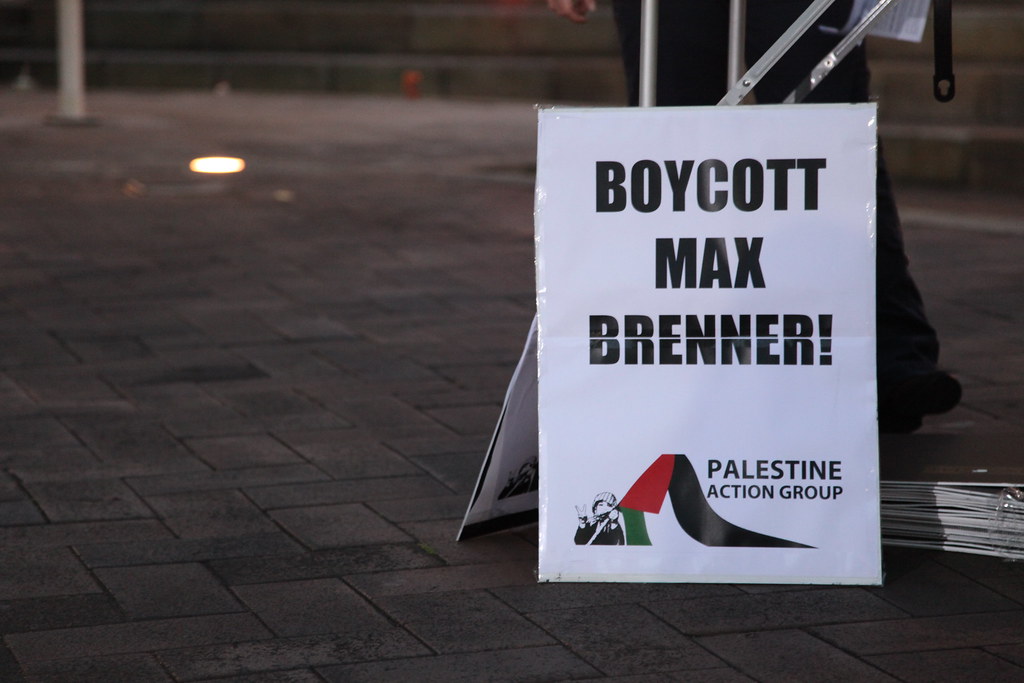
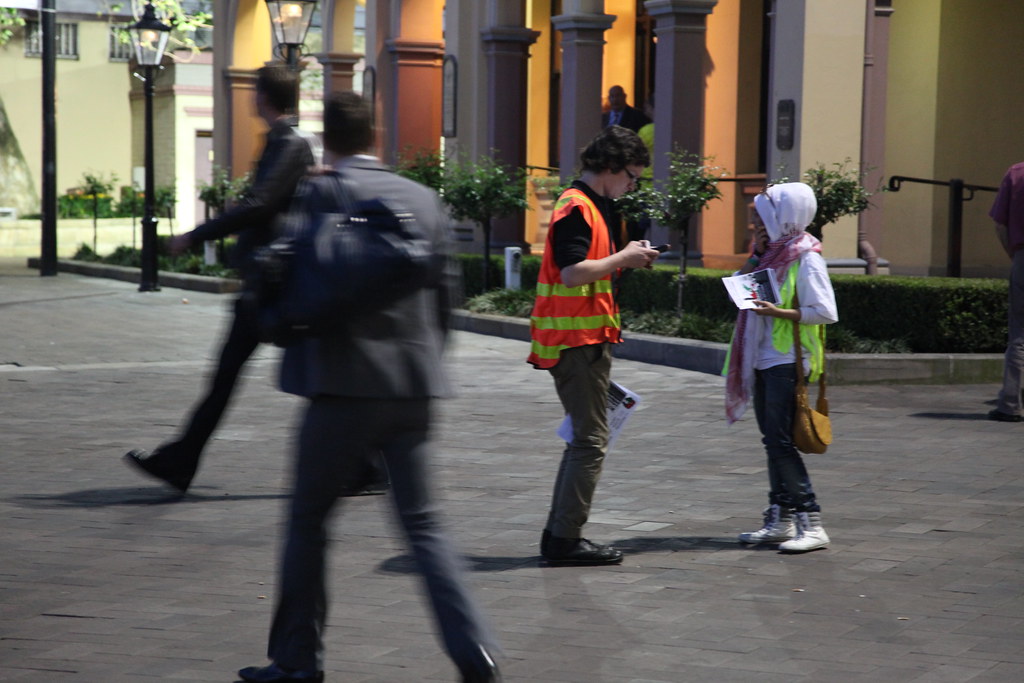
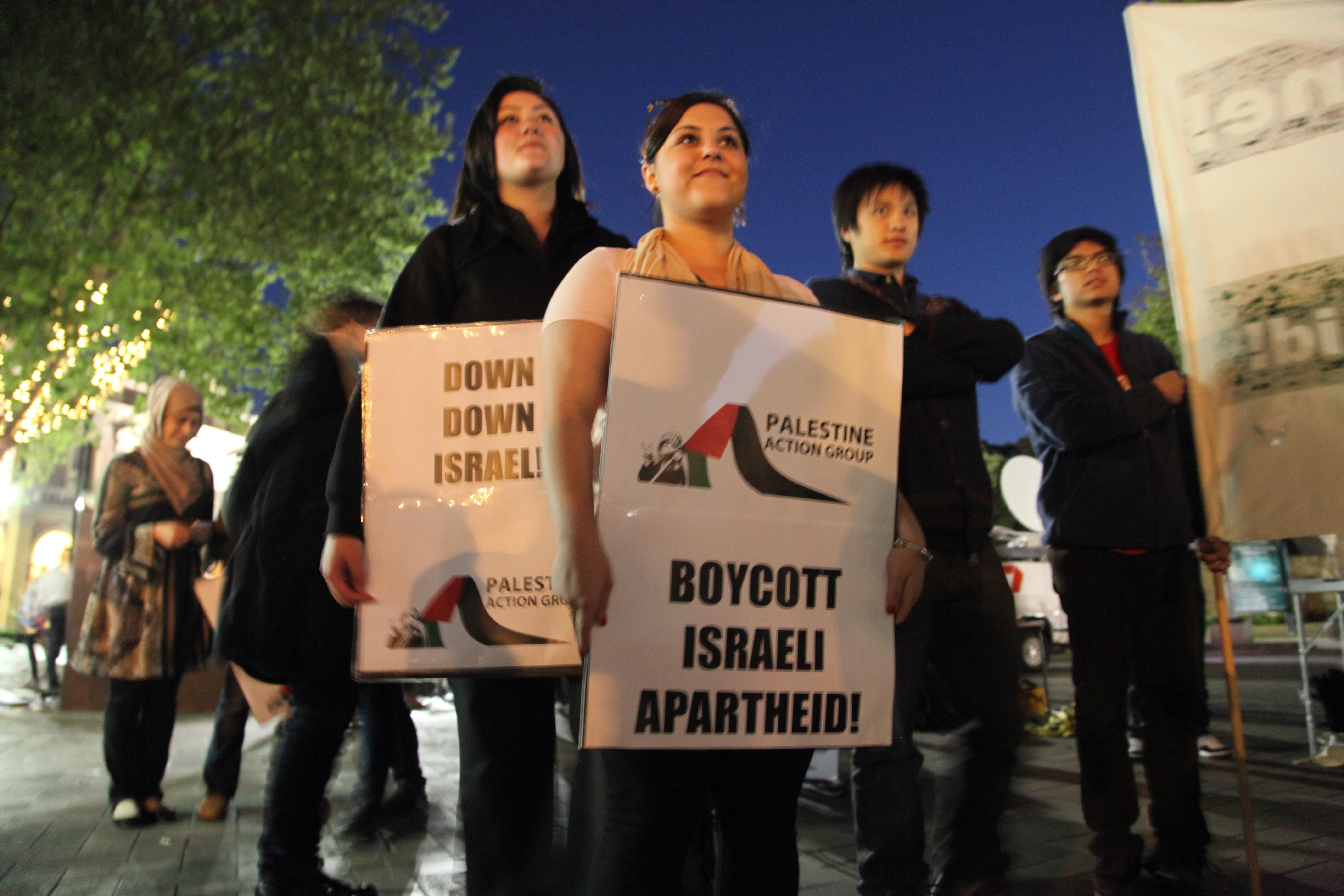
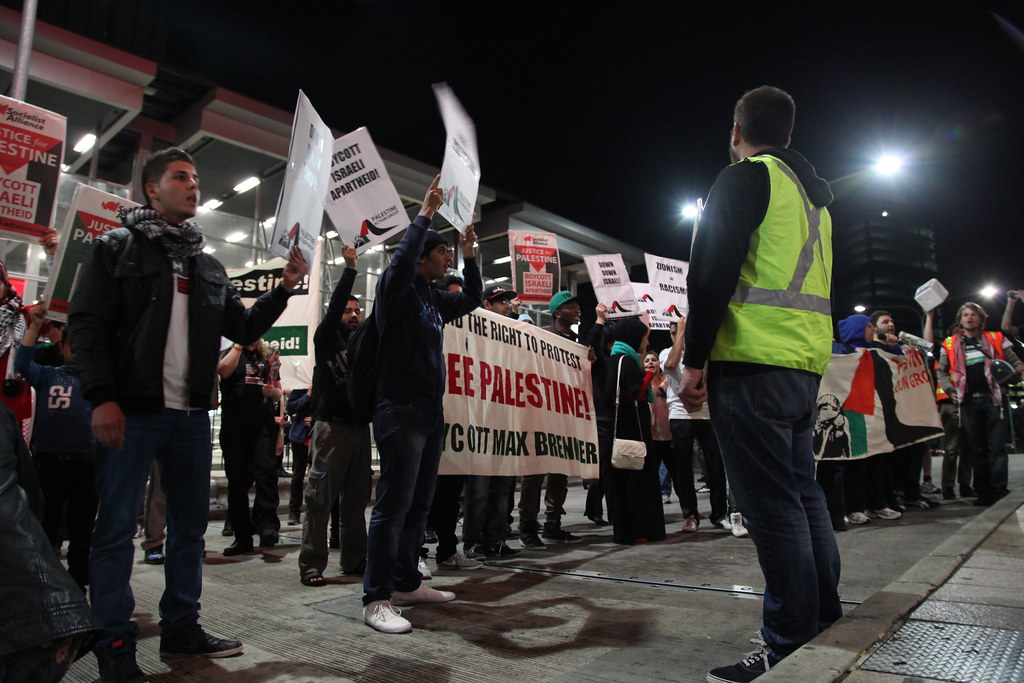
    Around 100-150 attended a September 20 rally and march at Max Brenner in Sydney's western suburb of Parramatta, organised by the Palestine Action Group, which I chaired.  The rally was in support of the global campaign of boycotts, divestment and sanctions against Israeli apartheid today. The protest was timed to also commemorate the massacres at the Sabra and Shatilla Palestinian refugee camps in Lebanon 30 years ago; the Golani Brigade, which Max Brenner's parent company, the Strauss group, donates care packages to, was involved in those massacres.


    Photos by Kate Ausburn, http://www.flickr.com/photos/treslola/sets/72157631580808970/with/8005982335/

    After the Muslim protests last weekend organisers were called in by the police and asked to call off the protest; after stating they didn't feel comfortable doing that, the police stated they would come to an agreement acceptable to both parties, while at the same time informing the organisers they had a high court summons for later that night if one couldn't be reached. However, the police do seemed to have learned from the last time they tried to take us to court for the Nakba day demonstration and it backfired; this time, they agreed to allow us the full use of the road for the alloted time, and to keep the riot police back so long as we marshalled the protest effectively. It all went really smoothly, we outnumbered the far-right pro-Israel mob drinking chocolate around 10-1 (as usual), and it was a really pumping experience!

    Photos by Kate Ausburn, http://www.flickr.com/photos/treslola/sets/72157631580808970/with/8005982335/

    Given the climate and the fact that shock jocks seized on our protest as a "follow up" to the weekend, there was a huge media presence. Of course this wasn't framed in the best way (and they took one of my less sharp moments to quote from, of course), but we got a bit of media from Channel 9. On the night I'm pretty sure 7 gave us a live cross to the news program, and PressTV and ABC Radio definitely got interviews too, although I haven't seen/heard them surface yet.


    We also got quite a decent write up beforehand in Sydney's City News, quoting myself from PAG, Haskell from Jews Against the Occupation Sydney, Rachel Evans from Socialist Alliance and a Murdoch Uni academic I don't know. After the interview I assumed they would play the "tapping into Muslim anger" angle (a lot of questions went in this direction) but they actually wrote something extremely favourable, running my quotes regarding Israel's colonial and apartheid occupation of Palestine. W00T!


    Photos by Kate Ausburn, http://www.flickr.com/photos/treslola/sets/72157631580808970/with/8005982335/

    I'm quite happy with the good work for BDS happening here in Sydney, even with all the Islamaphobia being heaped around we still managed to make a very good, peaceful and vibrant mobilisation, and we're in a great position to keep building this campaign and put some runs on the board in the fight against Israeli apartheid :) I'd like to commend everyone involved in this campaign sofar - Palestinian students, independant activists, socialists from different organisations, we've all been working together very collaboratively and have been well recieved to get real traction.

    Monday, 11 June 2012

    The Jersualem Syndrome

    Jerusalem Syndrome is something which I hadn't heard about before I travelled to the city in 2011, but you can quite easily guess what it's supposed to be from the name. For a land so replete with religious significance, it's probably unsurprising that around fifty tourists each year fall into some form of holy psychosis while wondering through sites of worship continually used for thousands of years. I was first told about the syndrome by a genial Swiss-Israeli woman living in the East Jerusalem hostel where I spent my first days in Palestine; she was using it to describe the actions of one of our fellow guests, who would climb the ramparts of the old city to stand guard at dawn. There are many such characters who perhaps do not think themselves the messiah, but feel compelled to do some duty in the Holy City.


    Damascus Gate, Old City of Jerusalem

    There are slightly darker sides to this story, of course; the obliteration of Palestinian connection to the old city in media reportage of this "syndrome" is near total. Neither the Wiki article on the topic nor any of its references even mention the word "Palestine" in describing this fever taking place, while the Israeli Ministry of Foreign Affairs is listed as author on an article in the Jewish Virtual Library on the topic. Academic writing on the topic has come entirely from Israeli authors; Dr Yair Bar-El, who classified the syndrome into three separate levels of psychosis based on previous mental health and religiosity, was a former director of Kfar Shaul Mental Health Centre, which deals with all cases of the syndrome - and which was built in the ruins of ethnically-cleansed Deir Yassin.

    The honourable exception is Haaretz, which compared the insanity of individuals suffering the syndrome to the holy war being waged by the Israeli government to legitimise their control of the city. Despite the fact that East Jerusalem, like the rest of the Occupied Palestinian Territories, is an occupied territory, the Israeli state exercises full military and civil authority over it (while denying residents the right to vote). In 1980 the Israeli Knesset passed a law declaring Jerusalem united and the capital of Israel, which was rejected by UN Security Council Resolution 478. But the theft of East Jerusalem was already well underway. From the moment of occupation in 1967, Israel set in place a long term plan to rewrite "facts on the ground" with massive settlement in areas surrounding East Jerusalem. Administrative boundaries, which had been set under the partition plan, were unilaterally redrawn by Israel in 1967 to include "“NO AREA” for future Arab Jerusalemite development":

    The new boundaries of the City were delineated for security and demographic considerations and in order to create geographic integrity and demographic superiority for the Jewish population in Jerusalem. In order to accomplish this, the redrawing of Jerusalem municipal boundaries excluded the densely populated Palestinian communities (the residences but not the lands) in the north, including Beit Iksa and Beir Nabala, whereas the sparsely populated communities’ lands in the south were included (Bethlehem and Beit Sahour)

    Settlements east of Jerusalem

    Today, the East Jersualem suburbs of Sheikh Jarrah and Silwan frequently flare up in protests against housing demolitions.

    There is a still darker side to the Jerusalem syndrome, and the narratives of "holy war" which use religiosity to justify oppression. An example of this is Denis Michael Rohan, an Australian tourist who attempted to set fire to the al-Aqsa mosque in 1969. He had previously worked on a Kibbutz in Israel, and was attempting to destroy the mosque in order to enable the biblical Temple to be rebuilt. For some, the political "holy war" should be waged biblically.

    Western Wall and the al-Aqsa Mosque

    Perhaps the breath-snatching surreal feeling I had the whole time I spent in East Jerusalem is a form of the syndrome, too. Even for a firmly non-religious person like myself, there is something overwhelming about the Holy City. It's a feeling I took with me everywhere in Palestine, which at times nearly brought me to tears. I found it immensely jarring to be walking the old city's cobbled streets looking for a reasonably priced laundromat! Every movement, every place, every word somehow seemed heavier than it would in Australia, more laden with significance.

    To me, it's the weight of human history, moreso than the religious assocations, which make Jerusalem (and Palestine) such a singular place. For thousands of years, untold lives have been sacraficed to control a single square kilometre of land. It's been destroyed twice, besieged 23 times, attacked 52 times, and captured and recaptured 44 times. Now, that weight of history and significance bears down on the residents of the old city; both those Israelis who see themselves as chosen people, and their attempts to cleanse the land as mandated by God, and the Palestinians, who with characteristic sumoud (steadfastness), refuse to buckle under the weight of discriminatory Israeli policies.


    Saturday, 5 May 2012

    Shout out to Teachers for Palestine

    So a friend of mine who volunteers in Palestine mentioned me on her blog. For the record, I haven't been able to spend as much time and energy on Palestine solidarity work since I returned to Australia as I'd like; however, stay posted for info on a Nakba day demonstration, and I've got my fingers crossed for a travel article about harvesting olives to be published in a local paper. So I guess I've been keeping busy :)

    I decided I'd give a little shout out to Caseceso and another one of my friends still volunteering in Palestine, E, who have been doing some amazing work with the English language teaching project Teach for Palestine for nearly a year now. They've both also been writing blogs about their experiences and adventures in occupied Palestine, constantly reminding me of how much I wish I could have stayed there longer, and putting together a great wealth of information about Palestinian society and culture and how it's impacted by the occupation. E in particular has written about women's issues in Palestine without buying into orientalist superiority narratives at all - figures, coming from a human geographer ;) Well worth reading.

    Sunday, 25 March 2012

    #OSyd Occupy Friday, 23/03

    On Friday night I headed along to the first (and hopefully not the last!) "Occupy Friday" night hosted by Occupy Sydney.

    We are the 99%
    It was a good response; I'd estimate that there was at least 50-60 people in attendance throughout the night, including around 40 marching down to the steps of the MLC centre tower, where the US consulate in Sydney is located, to show solidarity with #Occupy Wall Street protesters who have faced police violence in the last week.

    Mic Check: I don't think George Orwell intended 1984 to be an instruction manual...

    From the Facebook event:
    Occupy Sydney will be hosting Occupy Fridays beginning on friday the 23rd and continuing every friday after that. Occupy Fridays seeks to facilitate a hub for arts, free education, creativity and ideas. Occupy Fridays is open to anyone and everyone and will be an open source event; which means that anyone involved can contribute and participate in determining the destiny of Occupy Fridays and the future of Occupy Sydney as a whole.

    Occupy Fridays is a great way to engage for the first time or re-engage with YOUR Occupy Movement and explore alternatives to the current economic and social realities that govern our lives.

    On Friday the 23rd, there will be a variety of ways to get involved which are fun and educational, including:

    -Theme, The Australian Fun Exchange
    -Free school workshops & teach-ins planned, including a freeschool on the financial system and a "know your rights" workshop. Also for anyone who wants to spontaneously hold a workshop can do so!
    -Portugese conversation class at 10:30pm
    -Placard making area
    -Musicians Welcome and please bring your own instruments for jammin’
    - Kid’s section -3-4pm
    - Tiny Tents Task Force
    -Yoga Lessons
    - Friday Night Sustainable Cinema (Movie TBA)
    - Stencil making (for Occupy Sydney T-shirts and such, bring an old T-shirt and spare material for flags and banners)
    -Occupiers will be walking around getting voxpops from people for our "Have Your Say" project. If you'd like to contribute thoughts or ideas, they will be the strange people walking around with video cameras. They're pretty friendly. so don't be shy, get your voice heard!
    -Also, anyone who wants to take part, we'll be heading to the MLC Centre steps around 8pm ish and hold a candle lit vigil to show solidarity with our brothers and sisters at OWS who suffered this wknd at the hands of NYPD brutality. BYO candle!

    If you have any ideas or skills that you'd like to offer, come to the Occupy Fridays Working Group at 5pm on tuesdays, otherwise, come along, one and all! it’ll be a great night! Please come armed with ideas, musical instruments, a plate of food and a touch of mischeif!

    Occupy Fridays will be an overnight event, so if you'd like to bring sleeping gear and occupy overnight, please do so but no tents please as that presents legal issues.

    Occupy Fridays is also a drug and alcohol free event. Please respect that and make sure it remains a safe space for all participants!

    Please invite your friends!

    Support Occupy Sydney

    The fact that #OSyd has survived the summer, maintaining a presence at Martin Place (unlike any other #Occupy in Australia), is definitely a good thing. Free Schools draw in similiar numbers to the 50-60 that were down there on Friday night - but the Free Schools are more focused on discussion and less on taking action; from speaking with many of the longer term occupiers, this is the first time in a long time that such numbers have been part of political action with the group.

    There is a lot of thinking going on in #Osyd about what is the best way to move forward, to grow the movement now the initial excitement (read: media attention) over the idea of occupy has faded a little. The protest camp faces constant police harassment, as do individual occupy activists. In this context, I think events like Occupy Friday are crucial in mobilising people who, for whatever reasons, haven't gotten involved in #OSyd yet - or who got involved back in October then dropped away in response to the police harassment, their own time constraints and priorities, or whatever.

    To me, #Occupy Sydney is above all a movement for the dispossesed; the homeless, the unemployed, the workers, the "aussie battlers", everyone who is on the short end of the stick in this society. Only a small number of those people are dedicated, motivated and convinced enough to be part of an overnight camp of a small number of people who are going to face police intimidation. #Occupy, or any movement which seeks to say that our economic and political system is the problem, needs to find a variety of different methods of organisation that all of those layers of people can relate to within their comfort zone, while still seeking to draw those people forward into the struggle.

    Occupy Fridays seems to me a great tactic to do this; space for a variety of kinds of activism, collective mobilisation, and potentially building up numbers to renewed occupation on a scale the police can't just harass away. I think it's important that #OFri still maintains an emphasis political action, like the solidarity vigil, as well as organising and discussion. I'd encourage all socialists, anarchists and others seeking to change the system to come down to next week's Occupy Friday before/after the March to Jerusalem, and be part of the conversation :)

    160 days of occupy... and counting :)

    Sunday, 5 February 2012

    Free Free Syria

    I attended a anti-Assad Free Syria rally in Sydney today, which drew around 3-500 demonstrators to Hyde Park. Check out some crappy phone photos here.


    Tom looking shady... 


    Opponents of military intervention, many of whom support Assad for being a thorn in Israel's side, Syria's role in the "anti-imperialist" diplomatic bloc headed by Venezuela, or both, have been sharing this article by Pepe Escobar "exposing the Arab agenda in Syria". While I'd certainly agree with his analysis of the role the GCC & NATO are playing with regards to Syria and the Arab Spring as a whole, a lot of what he writes is pure speculation, such as:


    "The Syrian National Council is essentially a Muslim Brotherhood outfit affiliated with both the House of Saud and Qatar - with an uneasy Israel quietly supporting it in the background. Legitimacy is not exactly its cup of green tea. As for the Free Syrian Army, it does have its defectors, and well-meaning opponents of the Assad regime, but most of all is infested with these foreign mercenaries weaponized by the GCC, especially Salafist gangs."

    What the observer mission's report that Escobar quotes from has evidenced is that some parts of the civilian uprising have turned to armed violence. However, I've seen compelling arguments (from the BBC and other corporate media outlets, but also from activists) that many of these "shady gangs" are government-backed shabiha, like the baltageya in Egypt, committing acts of terrorism to intimidate the population while allowing the official armed forces to distance themselves. 


    As western observers and commentators I think we need to see some actual evidence as to the leadership, intention or composition of these armed forces before we start prosthelytizing against them. Many stating that the Syrian resistance is all "salafist" or "brotherhood" or "western backed" are the same people who have written off Libya's democracy movement as a CIA plot because of atrocities committed by some armed groups or the composition of the NTC, ignoring the fact that there are significant ongoing protests against the NTC by those who rose up against Gadaffi, especially in still-impoverished Benghazi. Why these people decided to protest now if their original protests were simply a CIA plot is anyone's guess...

    However, I do think that we can clearly say that the Syrian government is imprisoning and torturing dissidents, as it has for decades, and that we support the Syrian people's struggle for real democracy and against Assad. Just because he's an "enemy" of Israel or the US doesn't mean Assad isn't a ruthless unelected dictator. Even though there are opinion pieces in the Jerusalem Post calling for Assad's overthrow and dismissing the observer mission as a failure because it was "
    directed by the Syrian authorities to visit and report about places and incidents of the government’s own choice" (hardly true, given they travelled to several locations without a government escort) still doesn't mean he isn't a ruthless unelected dictator or the uprising against his rule shouldn't have our support and solidarity.

    The report itself documents violence against civilians by the military, the military by armed groups, and widespread suggestions that much of the armed groups are fighting back after 10 months of government crackdowns.


    "On being assigned to their zones and starting work, the observers witnessed acts of violence perpetrated by Government forces and an exchange of gunfire with armed elements in Homs and Hama."
    ...
    "The Mission visited the residential districts of Baba Amr, Karam Al-Zaytun, Al-Khalidiyya and Al-Ghuta without guards. It met with a number of opposition citizens who described the state of fear, blockade and acts of violence to which they had been subjected by Government forces."
    ...
    And perhaps most importantly:
    "The Mission has received requests from opposition supporters in Homs and Deraa that it should stay on-site and not leave, something that may be attributable to fear of attack after the Mission’s departure."
    - now, 5 days after the mission has withdrawn, there's been widespread reports of the arrest, torture and murder of civilians, which is where today's protests in Sydney, across Australia and the world fit in.

    There's certainly armed groups who are committing acts of violence against the military, the state and civilians. There's also certainly peaceful protest and opposition to Assad's regime, and Assad is also certainly attempting to crush and repress it. The report has shown that the escalating situation of violence is the result of that repression.

    Supporters of the struggles for freedom in the MENA region over the last year should above all reject all attempts to restrict or limit the gains that these revolutionary movements can win; whether that's the attempts to repress them by the dictators; directing the movements off the streets, out of the workplaces and into parliaments; foreign military intervention, which might save lives (or might kill more) but will inevitably make it harder for revolutionary movements to keep challenging the status quo once the dictator is gone, or limiting opposition to the regime into a dualistic narrative of pro-west/anti-west, islamist/secularist or whatever. Good people who oppose global imperialism who would otherwise support the resistance of a people to their oppressors are coming out to lie about, obfuscate about or straight up pretend away movements for change because they don't fit their conceptions of imperialism and the regional political balance, which is just what the forces of global capitalism want to see happen out of any interventions.

    Finally, in Australia's "free democracy" itself, the corporate media is showing its colours just as clearly as ever, getting this article up on the "attack" on the Syrian Embassy in Canberra while as of yet not posting a single shot of the protest marches calling for Assad to go in Sydney or Melbourne.