Showing posts with label australia. Show all posts

Friday, 3 July 2020

Here comes Hydrogen?

I restarted this blog to start writing some articles about climate change, but also to challenge myself to brush up on things I haven't read about for a while, and to learn things I didn't already know. The past few weeks have been a big exercise in learning things I didn't already know, with the big announcement on June 12 that a new company, H2X, wants to start manufacturing hydrogen-fuelled cars... right down the road in Port Kembla! So, while I've been twiddling my thumbs waiting for a sprained knee to heal, I've been looking into what exactly hydrogen means for the climate.

So... what does hydrogen fuel mean for the climate?

To answer that question, I've had to learn the answers to a few more. How does hydrogen fuel even work? How is it made?

The simple answer is, the same way as most other fuels - but unlike other fuel sources, when pure hydrogen is burnt, it releases only water vapour. Also unlike other fuel sources, pure hydrogen doesn't occur naturally - though it can be found in most fossil fuels, as well as in water. These are the three sources from which pure hydrogen can be derived for industrial use:


The former two sources are emissions-intensive, while the latter only produces the emissions that go into making electricity. Within Australia, these are overall quite substantial, making grid-fuelled electrolysis more emissions-intensive than any other source. However, with 100% renewable energy there are zero emissions generated (other than those that go into manufacturing the systems themselves).


Thus the various "colours" of hydrogen as outlined in Figure 1.1 - labels that describe how it was produced, and that suggest what hydrogen can mean for the planet. "Brown" hydrogen is derived from coal, "blue" from natural gas, "grey" from fossil-fuelled sources. The last sort, the one which excites environmentalists, is "green" hydrogen from renewable electricity-powered electrolysis.

Unfortunately, green hydrogen presently only accounts for 0.3% of hydrogen actually being produced. Around the world, steam reforming (blue hydrogen) makes up the largest portion of all industrial hydrogen production.

It turns out, quite a lot of capitalists in Australia are ready to start making green hydrogen. I first heard of the concept from Beyond Zero Emission's plan to make the Northern Territory a clean energy export superpower - a project which excited Atlassian's Mike Cannon-Brookes. At the time, the thinking was that nations in South-East Asia without our capacity to produce renewable electricity (like Japan and Singapore) would be the destination for green hydrogen from the NT. But, if H2X leads to a boom in domestic consumption, it might be right here in Oz.

After the H2X announcement I started looking into it some more, and it turns out there is a whole wealth of proposed green hydrogen facilities across Australia, including a number in Western Australia, the other main state not connected to the NEM and thus not able to share renewable electricity to the east coast in the traditional way. Thanks to seed funding from ARENA, up to $3 billion AUD of proposals are on the table.

That hasn't stopped our coal-loving Prime Minister from attempting to throw a lifeline to fossil fuel capitalists, by passing legislation to support brown hydrogen production from coal. The promise of carbon capture and storage being integrated into the production is a fig leaf, covering up the fact that there is no need to produce hydrogen in this way when we can do it in others. This is another front in the war on climate action - but it does also show that the coal barons know the writing is on the wall for coal-fired power, and they are looking for a new market to keep their mines from becoming stranded assets.

So, I've gotten a clearer picture on the climate impact of hydrogen... so if the hydrogen is "green", then switching cars from petrol or diesel to hydrogen should be great for the climate... right?

The big announcement for H2X was the "consumer halo", an SUV dubbed the Snowy. With a hydrogen-electric hybrid motor, it will have a range of 650km, and refuel in 3 minutes.

Concept art for the Snowy

That one has got all of the auto journalists excited and writing headlines dubbing it the "modern Ford" - but "the catch is that the hydrogen refueling infrastructure is no better in Australia than in the United States." Both the ACT and Queensland governments have announced they are installing fuel-cell hybrid infrastructure for their vehicle fleets, with hydrogen-powered Hyundai Nexos already on order. But for ordinary motorists, there is no practical means to refuel, and for this reason, Hyundai is only selling Nexos to government fleets for the time being. It looks like residents of the ACT will get the first chance for private ownership, with public access to the new refuelling infrastructure scheduled in a few month's time.

And that brings me to the elephant in the room - the fact that fully electric cars like the Nissan Leaf, BMW i3 or Tesla are already on the market and have started to reach the point where the charging infrastructure can support most people's needs. Like hydrogen, electricity is as dirty or as green as how it is made, but it requires no major supply lines or new fuel refineries to be set up - they already exist in the form of our grid. So will the Snowy reduce our number of petrol-chugging SUVs, or will it short-circuit the switch to electric vehicles?

There has been some commercial uptake of LPG over the last thirty years, which hydrogen could easily replace, particularly when it comes to buses. But electric vehicles seems to have beaten hydrogen off the mark here as well; Volgren in Victoria has already begun producing electric buses that are hitting the roads, while NSW plans to convert its entire bus fleet to electric.

H2X is no doubt aware of these limits, which is why the consumer halo of the private market isn't all they are looking at. ""Hydrogen fuel cell systems are greatly aligned to the power outputs required for tasks found in industry, mining and marine," Brendan Norman, the CEO and founder of H2X Australia, told CarAdvice."

Concept art for a hydrogen tractor, as seen on ABC

That's where this announcement is, for me, the most exciting. As of yet, electric vehicles for heavy applications haven't made a big dent in Australia. The headlines have hailed the "consumer halo", but the "industrial floodlight" (if you will) of concepts for tractors, vans and trucks that H2X has released are applications where hydrogen might have the edge over straight electric vehicles anyway; a big hydrogen tank that gets emptier gets lighter, whereas a big empty battery weighs just the same, and requires the same amount of energy to haul around. And it takes a lot of time to recharge, while hydrogen refuels in much the same way (and with much the same speed) as conventional petrol or diesel.

H2X plan to start manufacturing up to 20,000 vehicles within 5 years. That sounds impossibly ambitious - until you hear the qualification that the vehicles will only be "80%" made in Port Kembla, built around imported drivechains. Shipping major components from Europe or the Americas does increase the carbon footprint of manufacturing these vehicles, but if it means they are able to start getting made and reducing emissions from our transport sector (#2 only to energy generation itself) soon enough to make a difference for staying within our 1.5c timeline, it may be an acceptable cost.

So is this the kind of change we need to see?

The South Coast Labour Council teamed up with Labor and Greens politicians to relaunch a Green Jobs plan for the Illawarra in 2019. They are calling for the shrunken industrial district of Port Kembla to be revitalised as a hub of investment in green manufacturing. The 5000 jobs that H2X says it will create are, no doubt, a welcome answer.

The focus of the plan has, naturally, been the single biggest contributor to Australia's greenhouse emissions - energy generation. Right now, despite the growth in renewables in the last two decades, there are only one factory in Australia each manufacturing wind turbines and solar panels. Port Kembla, as a location with steel supply lines and infrastructure already in place, would be an ideal location to build a 100% renewable grid, and avoid the emissions of transport.

H2X plans to make hydrogen cars, and is looking to make a business case for it without government support. But we cannot leave the survival of the climate we depend on to decisions based on what is or isn't profitable. In this era of pandemic and recession, we can and should be demanding nationalised industries which create profit for the public, not a few capitalists.

Saturday, 30 May 2020

Can you live a 1.5c life? Pt 3

Part one of this series of posts on the 1.5c life challenge is here. Part two is here.

Let's wrap up the first email of Australian Ethical's 1.5c lifestyle challenge (it's now over three weeks into the challenge after all!) so I can move onto the more meaty topics of future emails...

I'm not going to spend so long breaking down the numbers on the final actions from the first challenge email, mostly because it's hard for me to figure out my own exact numbers or translate them to the whole country. I'm just going to examine how much potential they broadly have, as individual actions or as collective solutions, and the personal ways I'm trying to up my game.

Part three of the challenge is: keep your home well insulated. The individual actions in the challenge are:
• draught-proof your home with door snakes and curtains
• invest in carpets and rugs – this helps stop heat escaping through the floor
•close off unused rooms in winter and help to reduce heat loss.
• close curtains and blinds to keep the heat in or block the sun out
The connection of heating, cooling and insulation to climate change is well understood in Australia, especially since the Rudd government's "pink batts scheme" which resulted in the deaths of four workers and became a political wedge for the climate-denying opposition.

We already did almost all the things on this list - as residents of a north/west facing rental apartment, we have no choice but to control our temperature passively. We have used a small portable A/C unit in the past, but this apartment has no compatible windows, so in the summer, all we can do is try and shade ourselves and catch a coastal cross-breeze when we can. And in the winter, our glass sliding doors catch the afternoon sun, keeping us cozy so long as there's even a hint of daylight. Our electicity use barely spiked during a cold wet spell last year. The only thing on the list we haven't been doing is using a door-snake to prevent a draught; I've improvised one out of a felt blanket for our front door, and although May has been unseasonably cold for coastal NSW, we haven't had to fire the heater up yet.


I guess I am living a 1.5c lifestyle on this front, then. But I am not going to even calculate how much difference it would make if every Australian lived like I did, because the concept is fundamentally flawed. Our ability to live with a low heating & cooling footprint is intimately connected with the design of our buildings and the appliances installed during construction.

The Beyond Zero Emissions Stationary Energy Plan discusses what an important role buildings, temperature control and insulation have to play in getting Australia to a zero carbon energy grid. For most of our country, the biggest challenge to getting renewables in the grid is the evening peak, as I discussed a little in part 1 of this challenge. Right as the sun is losing intensity or setting, we get home from work, and switch on the air conditioning and cook our largest meal of the day. We have ended up this way, in the plan's words, because "the cost of electricity in Australia has historically been low compared to other developed nations, allowing lowest initial-cost building practices and inefficient design to persist as the norm." So long as electricity is cheap, it's cheaper, simpler and easier to switch on the A/C and pay the annual cost than it is to build our houses well in the first place.

Taking passive, low-energy measures like those of the 1.5c challenge can help us to flatten that peak, but they can only do so much when most of our homes are built like "glorified tents". Not every Australian can live within 1km of the ocean like we do, and catch a cooling afternoon breeze. The BZE plan, on the other hand, identifies policy-level actions which could reduce electricity consumption from buildings by 36%: a program for double-glazing and insulation installation (like the infamous pink batts debacle), and totally phasing out gas as a source of heat and cooking in favour of efficient electrical appliances like induction cooktops and heat pumps. 

These higher-impact actions are difficult to take as an individual working within a market-based system. The cost of replacing an old cooktop and water heater with newer, more efficient models is prohibitively high; the only people I know who have done it are those who have made the decision (and had the means) to renovate their kitchens. Better insulating your house has a lower initial cost and will pay for itself in reduced energy consumption - but so long as natural gas or an inefficient electrical appliance is the source of your heat or cooling, greenhouse gas emissions will still result.

If you are a renter like us and approximately 30% of Australians, you might be able to negotiate with your landlord to split the cost of these upgrades - but if you don't own the asset and can't be sure you'll live there long enough to recoup even part of the cost on lower bills, why would you bother to invest in upgrading it? As much of a disaster as it was, we need a new pink batts scheme, or other society-wide measures to retrofit insulation and efficiency measures.

So long as our housing stock remains inefficient, individual actions cannot reduce emissions within the level of a 1.5c trajectory. Most of the houses currently in supply or being built will still be around by 2050, by which time we should clearly have reached net zero. Even today, 80% of houses are currently being built to the minimum standard of efficiency, which isn't even cost-effective over the life of the building. Australia will require collective actions on the level of policy - especially improving minimum building standards and. phasing out gas as a source of energy - to improve our efficiency and bring ourselves to net zero.

As far as heat generation is concerned, there is a significant untapped resource in Australian cities near industrial hubs, too: cogeneration. While in Australia, most studies have examined the use of gas or biogas inputs for cogeneration, there are examples overseas of capturing waste energy from other means - for example, Sweden harnesses the landfill gas I discussed in the last post to burn for both heat and electricity, while Copenhagen is almost fully heated by a centralised system that captures the waste heat from the city's electrical plants and circulates it as hot water. These systems require municipal or governmental action, even if they are broadly popular.

For the sake of brevity, I'm going to leave that point there, and quickly address the final target of the first week's challenge: reducing your consumption. The personal actions are:
• swap or borrow clothes if you need something new
•if you see something you want, wait three weeks before buying it –
if you’re still thinking about it, then buy it.
• try not to buy anything new for a month
I work in sports fashion retail, so I know how much of a problem fast fashion is. The bread and butter of our business is people who shop for new outfits for exercise and daily wear multiple times a year. All the extra production this leads to means each item has a higher carbon footprint. Since the year 2000, fashion consumption has gone up by 60%, and it now accounts for 5% of global emissions - more than shipping or aviation.

I'm not going to try and figure out how much I could save or how much difference it would make if every Australian took the challenge on this one, mostly for brevity. It is more of a marginal contribution than electricity, food waste or even household heating, but could do more than individuals voluntarily avoiding flights - like the climate activist Greta Thunberg has famously started doing.

I'm just going to say that, with a little reflection, I'm probably not living a 1.5c lifestyle right now, given the amount I consume. So I've started on the three week rule - even setting myself google calendar reminders once it's been three weeks and I can review if I really want to buy something - and sofar, it's helped me to avoid impulse buying several things, including clothes and household appliances.


Perhaps in a few weeks, I can review how this has gone (as well as my food waste reduction efforts). But let's move on from this first week of challenges for now. Next time, I'll write more about the second email, on ethical investment for the climate.

Sunday, 17 May 2020

Can you live a 1.5c life? Pt 1

1.5c is a pretty important target, as I've written about here. Even under the best case scenarios, the human race has already locked ourselves in for a lot of misery thanks to climate change, but if we can't keep ourselves to under 1.5c of warming, we will almost certainly be creating an extinction-level event. So I was intrigued to see my super fund, Australian Ethical, wanted to tell me "How to live a 1.5 degree life" - and even wanted me to take a "living a 1.5-degree life challenge" this month.

Since I've been doing a lot of reading about the climate science of this target, as well as the politics of action to get us there, I thought I'd better take the challenge and make sure I'm doing all that I personally can - but also run the numbers, and see if they actually add up. I'll do this over the course of a few posts, as the challenge emails come in.

I'm going to set out a bit of a conceptual framework here, as a whole lot of maths isn't really my strong suit. If every Australian made these lifestyle changes, would that alone really put us on track to the reductions we need to keep to our Paris Accord commitments and no more than 1.5c of warming? Of course, Australia has a small population - but we are the fourteenth largest emitter, and one of the highest per capita emitters, with only small island states or countries with oil-centric economies ahead of us. We can, and should, lead the way, not drag our heals and continue to beat the drum for fossil fuels.

So, what are the personal actions Australian Ethical wants us to take?

Number one on the list is switching to renewable energy, either through rooftop solar if you can, or switching to a renewable provider (like Meridian, which the Australian Ethical video admits they invest in).


Now, I'm a renter, so I've already done as much as I can right now - made the switch to Powershop, the subsidiary which retails Meridian's renewable electricity. I did this well before I switched my super to Australian Ethical, back when my partner and I started renting again at the end of 2018, after being referred by a local environmental activist, and I've since referred one fellow activist on myself.

I've passed the first step of the challenge. But am I living a 1.5c life?

What would happen if every Australian did this? The simplest answer would be, we would all have renewable energy. But the grid doesn't work that way. Australia is comprised of one main grid or "market" - connecting the east and southern coast states (the National Energy Market or NEM), with others for Western Australia and the Northern Territory. A big part of Beyond Zero Emission's roadmap for a 100% renewable grid in Australia is connecting all the state grids from east to west, so that energy can be moved from regions where renewables are producing to those where it is not. The entirety of section 5 of the plan is dedicated to grid upgrades.

The website OpenNEM actually displays the contribution renewables are making to the NEM over time, if you are interested in diving into the numbers:

OpenNEM snapshot on May 17
The black and brown bars contributing most of our power are coal. In the past year, coal contributed 67% of the NEM's electricity. Powershop's parent company may sell renewable energy to the market, but, as they point out in a recent blog post, they cannot guarantee where the actual electicity arriving down the wire is coming from - and especially in peak times on windless summer evenings, most of it will be from fossil fuels. That is why Powershop also buys carbon offsets, to "undo" the damage being done by that coal power they are selling.

If every Australian started buying only accredited green power from Powershop or other retailers today, it would not solve the fundamental issues with that market within the time frame that we need. The immediate rise in price of green power certificates and carbon offsets would make projects selling renewables a lot more profitable than coal, but without a coast-to-coast smart grid with substantial built-in storage, it won't allow for us to switch of all of our coal-fired power within a decade. That would take major intervention by government or large capitalists.

In fact, it is the present system of markets and price signals which has, so far, failed to deliver on the most significant untapped form of renewable energy in Beyond Zero Emission's report: Concentrated Solar Thermal. In Port Augusta, a plant was proposed, with the backing of the entire local community. But it failed to drum up sufficient up-front capital, and was bought out by company 1414 Degrees - who plan to build traditional photovoltaic solar instead, and add storage later, to reduce the upfront capital cost. 


This is the exact kind of slow, insufficient change that leaving electricity supply up to the market has given us already. From a mandatory renewables target of 5% in 2001, the NEM reached 26% of energy coming from renewables last year. 

Every Australian buying from a renewable provider might drive change a little bit faster than that increase of 21% in 19 years. That's what Powershop's argues on their website:

By purchasing GreenPower you’re minimising your impact on the environment and it means additional RECs are surrendered over and above the compulsory requirements set by the Renewable Energy Target. This clearly demonstrates that there’s a demand for renewables leading to continued growth, investment and promotion of the renewable energy sector.

However, this isn't actually the case. Australian consumer watchdog Choice has warned that GreenPower certification certificates won't lead to any change beyond what our governments have already committed to doing:

Back in 2009, CHOICE complained to the ACCC about misleading GreenPower claims in relation to emissions reductions that were in breach of Australian Consumer Law. After consultation with the ACCC, GreenPower directed electricity companies to change their marketing language – they could no longer say that buying GreenPower lowered emissions or had an 'environmental' impact... if you're hoping for an environmental benefit in the form of cutting Australia's emissions, beyond what the government has already committed to deliver, it's not.

In other words, when it comes to renewables, market mechanisms can't do the job of bringing us in line with a 1.5c target, unless the government introduces policy that matches it - like 100% renewables and net zero by 2035. 

I am not living a 1.5c life.

There is another part of Australian Ethical's ask that I haven't addressed, as it doesn't apply to me, as a renter in a strata-managed building: buying and installing your own rooftop solar photovoltaics (PV). If I owned my own house and generated my own solar, could I be living a 1.5c life?

Right now, there are 2.37 million solar PV installations on rooftops around the country - 21% of all houses, and rooftop solar generated 11,000 gigawatt hours for the NEM in the last year - 5.7% of the market. So if all households in Australia (somewhere around 11 million) generated at the same rate, we could have about 28% percent of our electricity coming from rooftop PV. 

There's a number of problems with this maths, too, though. Once again, technical issues with the grid hold us back. Our grids are designed to take power from large sources and distribute it down the line. Houses providing their own electricity takes load off the grid, but if they try and start feeding it back in on that kind of scale, the energy companies warn it could cause power surges, leading to local transformers tripping off and localised blackouts. That is, unless they slug us for upgrading the grid.

Audrey Zibelman, head of the national regulator AEMO, wrote about the troubles with this approach earlier this year, when they said Australia could be seeing days of 75% renewables within 5 years - but at that point, the regulators would need to update inverter standards and make other reforms, or renewable contribution would have to be limited to 60%. AEMO projects that amount could rise to 90% renewables by 2040 - heartening, but well outside of the point Australia should have already reached net zero to stay consistent with 1.5c of warming.

So, if I wanted to live a 1.5c life, I would have to disconnect from the grid completely, and go "off-grid" with in-home storage like a Tesla Powerwall and rooftop PV. For my partner and I in a small, two-bedroom house (apartment, actually) that would set us back $15,000 - $25,000 AUD; for the average household with 4 bedrooms, this could be up to $40,000. This is inefficient compared to the economies of scale of large solar and wind farms; it also leaves me out of pocket for the up-front cost, not a government or utility corporation.

That leads me onto another big part to this equation, which is the concept of climate justice. As well as applying to the gap in contribution between already developed and currently developing nations, climate justice also applies within developed societies. Massive fossil fuel companies and governments made the decisions that led to our grid being set up to still be running on coal power when a fully-renewable grid could be up and running today. Capitalists have continued to rake in massive profits over the years, even though they have known their investment was causing climate change for decades. 

Yet, if every house makes the same contribution by paying the cost to go off-grid, the individuals who made those decisions would pay the exact same cost as those from the massive majority of society who never had a say. That is not climate justice.

I'll deal with the other main points of Australian Ethical's first challenge in my next post.

Part two of this series of posts on the 1.5c life challenge is here. Part three is here.

Monday, 11 May 2020

Out of the woods, pt 3

This post is part three of a series. Click here for part one and part two.

So, I've looked at the climate science of forests and woodlands, and what part deforestation and bushfires have played and will play in climate change. In this post, I'll talk more about the climate politics of how we can get on the right track, the track into more woods.

What can we do to change our path?


Peter Camejo's classic speech from the Vietnam war era, Liberalism Ultraleftism or Mass Action, has been a guiding light for me ever since I came across it. So I'm going to group the current and historical campaigns to stop deforestation and protect our woodlands into those three broad categories - liberal, ultraleft, or mass action strategies.

Liberal strategies for stopping deforestation revolve around appealing to the good conscience of the ruling class of society. This can mean appealing to the government to pass better laws to protect the environment, activists chanelling their energy into petitions or utilising the existing laws; it can also mean appealing to the capitalists doing the deforesting directly.

An example of the latter is the current Wilderness Society asking you to sign mass letters to the CEOs of major companies, demanding that they make policies or statements to remove deforestation from their supply chain. The WWF's Global Forest & Trade Network is another example, creating a market for responsible forestry. These tools might sometimes work - I like to believe that most people have a good heart, after all - but in a capitalist society, where competition and the profit motive are hard wired into the system, any business who choses a more expensive means of production on moral grounds risks being undercut by those who aren't so ethical.

The former kind of campaign includes the Nature Conservation Council's campaign to declare a moratorium on logging in public forests. Again, petitioning the people in government in a capitalist society, who almost always see their job as upholding the dominant class interests in society, is only going to lead to slow, incremental change unless they think the issue is going to win or lose them an election - and that is largely determined by a news media world growing ever more determined to uphold the class interests of those in power themselves.

The best a liberal campaign asking the government for action can deliver is Victoria's ban on old growth logging in 90,000 hectares of the state; the plan has a sunset clause for existing logging activities until 2030, and green groups have concerns that the new zoning might reclassify areas currently considered "old growth". It's identifying the path we need to go down, but leaving the real kilometres of it to a future government, when it has the power to take that path today.

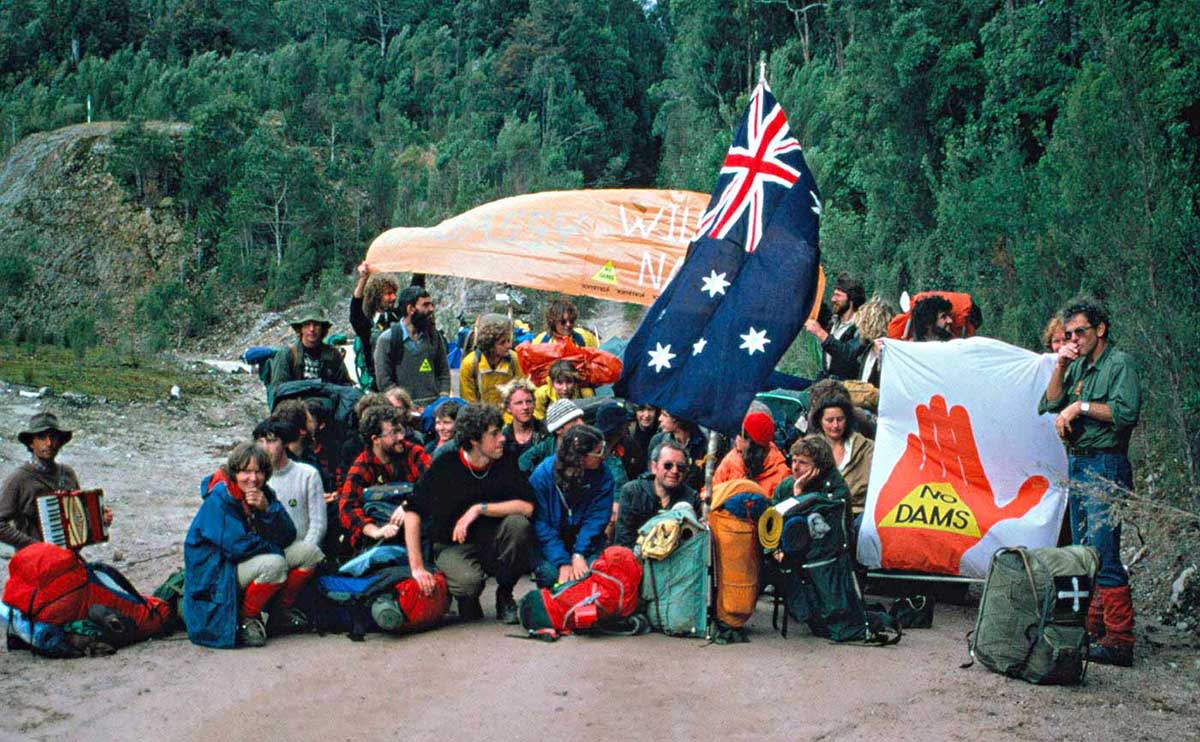
Protesters at the Franklin River, 1982

Then, there are ultraleftist strategies. They reject liberal ideas about appealing to the good will of the ruling class, and don't want to work within the boundaries of the democratic system. But they still don't see an alternative to the power of the ruling class or the government; instead, they involve generally small numbers of people in militant tactics that "break the rules", hoping to convince the ruling class that the cost of doing business in this way is too high. These tactics always appeal to those looking inward, within a small radicalised community, and trying to find some shortcut to change.

The most succesful example of this kind of strategy is Miranda Gibson's tree-sit to protect Tasmania's forests. She climbed up a tree in an area scheduled for logging in December 2011, putting her body in the way of the saws to demand the Styx valley, home to the world's tallest hardwood trees, be added to Tasmania's World Heritage Area. After over a year of her sit, with international attention on the cause, the Federal government announced an extra 170,000 hectares of forest would be nominated for protection. Gibson still holds the record for the longest tree-sit in Australian history, at an astonishing 449 days.

As great a victory as this was for Australia's woodlands, these kinds of tactics alone cannot protect forests for good. Companies will gladly sit out individual actions, or even empowered communities. This is apparent in the bid by Tony Abbott's following government to have the forest delisted - thankfully, one which failed. But they will try again.

Gibson's campaign gained so much success because part of her strategy was also to share her story, via solar-powered computer, and win mass support for the campaign. And this brings us to the third strategy for change identified by Camejo: independent mass action.

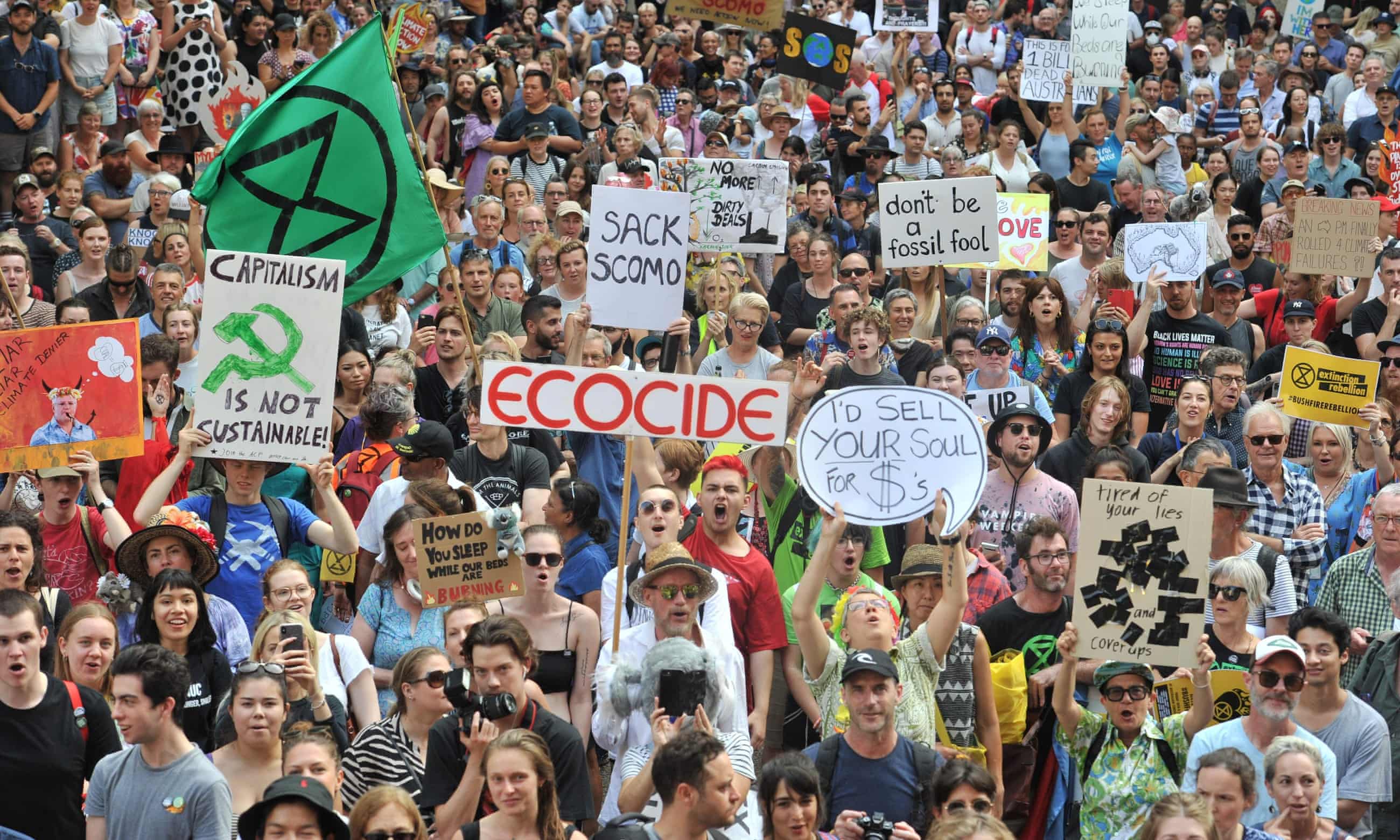
Bushfire crisis protest in Sydney, January 2020

An independent mass action strategy aims to challenge the power of the ruling class - not by activists going through the democratic channels, or by making small militant actions, but by looking to the other great class power in society - that of the working classes. Its aim is to draw the great masses of society into struggle themselves, not struggle on their behalf. It aims to break the rules - not the laws that say we can't protest on private property, but the fundamental rules about who owns society.

The simplest understanding of an independent mass action strategy is that it aims to call mass street rallies. And this is an important tactic; for the environment movement, the most recent examples of mass rallies which cut through the white noise and brought masses into action in Australia are the #climatestrike and School Strike 4 Climate actions of late 2019. They were followed up by the bushfire emergency rallies demanding the government do more - to protect the people, and landscapes, vulnerable to climate change through better funding for emergency services and meaningful climate action. Those Australian and global mass actions, while unsustained, have led to a real shift in the conversation on climate change in this country.

However, independent mass actions don't only mean the one tactic of street rallies. They can use any particular form of activism that brings masses into action, with a goal of exercising their own power, rather than appealing to the ruling class.

Worker's struggle, in the form of strikes, is another key tactic in a mass action perspective. Today in Australia strikes are only allowed while negotiating a new agreement, but we have a proud history of worker's strikes for the environment in the form of green bans - the campaign by the Builders Labourers Federation (BLF) to protect parklands and historic sites within Sydney. In the initial fight to protect Kellys Bush Park, the workers threw down the gauntlet to developer AVJennins:
If you attempt to build on Kelly's Bush, even if there is the loss of one tree, this half-completed building will remain so forever, as a monument to Kelly's Bush.
Today is a sad day for that history; Jack Mundey, the leader of the NSW BLF through those struggles, has passed away at age 90. May he rest in power.

The green bans campaign was one of the most effective forms of independent mass action ever used in Australia. It utilised the independent power of the workers, uniting with environmental and anti-corporate activists, against the wishes of capital - tying up $3 billion (in 1974 AUD) of investment. This independent mass action had to be quashed, and so the federal leadership of the union intervened, standing down Mundey and ending the policy of green bans. Of course, it later turned out the federal leader of the BLF, Norm Gallagher, was taking bribes from the construction bosses, leading to the closure of the BLF and its replacement by the CFMEU.

The CFMEU is militant in action for wages, but it has inherited the anti-environmental perspective of the latter BLF. Taking down the "24 hour construction sites" and pro-fossil fuel bureacracy of the CFMEU is a key struggle for climate activists. A CFMEU green ban ban on cutting down old-growth forests would bring the industry to a meaningful halt, and stop devestating climate change. The CFMEU leadership might be deluded enough to think climate change isn't an issue that will impact blue-collar workers in Australia, or that they can't adopt a more radical stance - but the history of the BLF shows otherwise.

These campaign strategies or orientations are far from exclusive - and they can sometimes bleed over into each other, or be complimentary. Individual tactics can fit into any of the three perspectives. Mass rallies can make liberal demands, direction action tactics can compliment legal or mass campaigns. Miranda Gibson's tree-sit did exactly this. And Tasmania's best-known fight to protect the environment, the fight to stop the Franklin Dam, utilised all kinds of tactics - including a write-in campaign on the 1981 state referendum that won an astonishing 45% of the vote.

So, what should you do right now?

I encourage everyone to get involved in all of the above kinds of campaigns to protect our forests as much as they feel is right. From my point of view, though, both the severity of the climate crisis and the centrality of capitalism in the crisis, mean we must take a mass action approach to climate activism.

Friday, 8 May 2020

Out of the woods, pt 2

This post follows on from Out of the woods, pt 1.

The Australian bushfires fires of last summer feel like a lifetime ago now. I was lucky enough to live in a region that wasn't directly affected, although we were bordered by both the Currowan and Green Wattle Creek fires which devestated villages I know well. Relatives further down the coast lost their homes and were trapped for days. And all of us on the east coast spent months under more or less of a smoke haze, some days so strong it was hard to breathe. Residents of Canberra, a natural bowl, had the worst of it, but even in Sydney, the Opera House became invisible from across the harbour. For myself, I knew it was a bad day when I woke up and couldn't see Mount Keira three kilometres away. The anxiety was constant, and the relief of the drought-breaking rain in February was immeasurable.

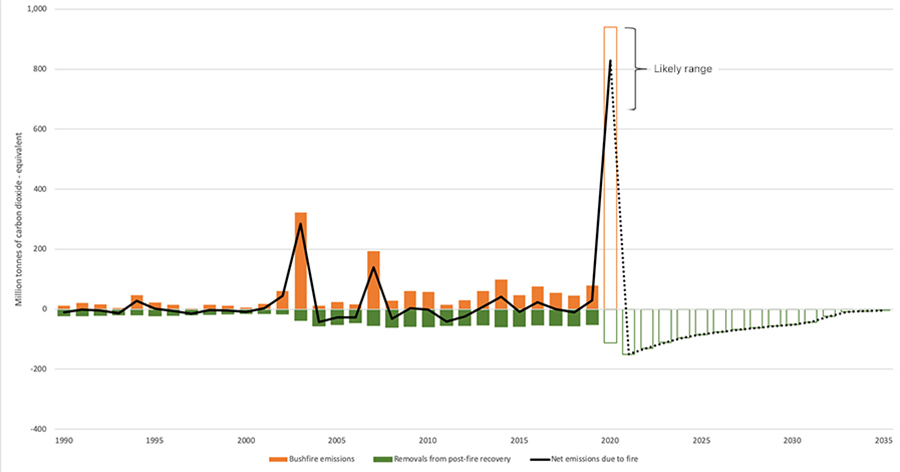
What did the fire season mean for climate change? In the simplest terms - 830 million tonnes of carbon dioxide emitted. There are only five nations who emitted as much carbon as the fires into the atmosphere last year: China, the US, India, Russia and Japan. By far, they burnt the largest ever amount of temperate forests in Australia's historical record.


But the actual impact is a little more... well, hazy.

A word on the misdirections toward arson and backburning before I get into the science. NewsCorpse columnist Andrew Bolt was one of the many conservative commentators who tried to undermine the shift in consciousness that occured during the fires by blaming either deliberate arson or green tape preventing hazard reduction burning. They have been rebutted elsewhere in depth, so I won't spend this post explaining why they are wrong; however, for anyone who is interested in deliberately-lit fires, I recommend Chloe Hooper's book, the Arsonist, which details exactly what happened in one such case.

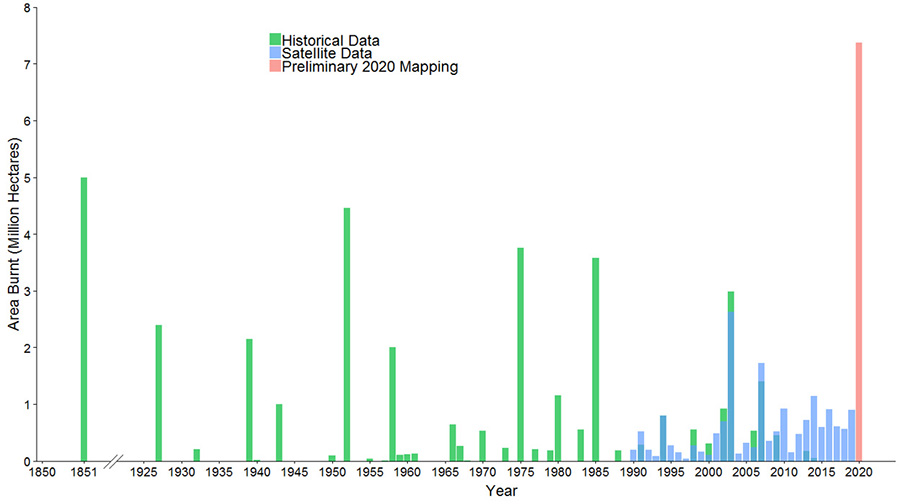
However, reading the technical update by the Department of Industry, Science, Energy and Resources (hardly a bastion of the culture wars) put Bolt's claims that the fires weren't the "largest" we've ever experienced to bed. The above graph, taken from that update, shows the devestation of temperate forests in Australia; savanna fires may cover far more area, but they represent far less destruction of endangered species, loss of habitat and biodiversity - and release of carbon emissions.

But what does the technical update have to say about the hundreds of millions of tonnes of carbon released into the atmosphere by the fires? In essence, that they don't count - at least not for our National Greenhouse Accounts or reporting to the IPCC. Most of the time, bushfires don't actually kill off trees in temperate Australian forests, only burn the bark, leaves and understory shrubs. As such, new growth will draw almost all the carbon released back out of the atmosphere within 10-15 years.

Is that really the case? Thankfully, we have had months of sustained rains in most of the coastal areas. They may have fallen down the page amidst the pandemic, but images of forests sprouting green new growth after the fire have done the rounds on Australian social media. The initial signs are good. However, it is only some kinds of trees which can regrow under such conditions. The fires burnt in rainforest areas previously thought safe, and may have wiped out many species.

It will take the forests a long time to draw down that much carbon, and in the short term, we are seeing a huge spike. During the fires, the British Met Office estimated we would hit a peak of 417 parts per million (PPM) of carbon dioxide in the atmosphere this year thanks to the fires. We have actually hit a recorded high of 418 on May 3rd. 450 PPM is almost certainly going to tip us over the line to a dangerous 2c of warming and runaway climate change, which I wrote a little about in this post.

The spike will only go back down if the forests that burned are able to regrow for 10-15 years, without drought or future fires. This is almost guaranteed not to happen if we don't immediately address climate change, as this graph from the technical update hints. The negative green bars are showing the amount of carbon being drawn down by regrowth after fire, the orange the amount released. The more frequently severe bushfires occur, the less "carbon neutral" they become.


We must fight to protect forests in the wake of the fires. I will talk about the climate politics around forests in the final post of this series, but the most important thing to remark on here is to massively expand our bushfire fighting capacity. The priorities in Australia's bushfire fighting efforts were to protect lives first, property second, and forests third. We need to incorporate the urgent need to protect regrowing temperate forests from bushfires to maintain their status as carbon sinks, and intervene early.

That means more permanent volunteer payment provisions, and expanding equipment available to put fires out before they become too big to fight. In the fire season, aircraft and specialists had to be called in from overseas, and the state and federal governments all passed the buck on footing the bill. To buy C-130 waterbombers outright costs in the tens of millions of Australian dollars.

Celeste Barber's $51 million dollar Facebook fundraiser for the fires is a great step in the right direction, as the NSW Rural Fire Service must put the money towards equipment to expanding the Service's capacity to fight fires. It recieved over $100 million in donations throughout the crisis. Unfortunately, although Barber's fundraiser was clearly dedicated to the RFS trust, it's not exactly what people had in mind, as the description suggested it would help rebuild devestated communities - the RFS is currently exploring ways it can do both.

As runaway climate change becomes more and more inevitable, climate activists shouldn't only be fighting to "stop" climate change, but to fight for the greenhouse polluters to pay for the cost of defending communities from fires, drought and floods, and demand that they foot the bill when communities are destroyed. This call gained some traction during the bushfire crisis, but not enough. As with major devestating events in the past two decades, the job of rebuilding has largely been left to insurance companies, whose goal is to profit from the situation - by jacking up insurance premiums on the people most affected.

Which of these two responses plays out - the cost being placed on those responsible or those affected - will depend on the climate movement, and our ability to take up arguments around climate justice and bushfire justice. I will expand on that more in the last post in this series.

Thursday, 30 April 2020

Out of the woods, pt 1

I have been getting into the woods a lot lately. Last year I started including trail running as part of my habit, and tackled my first big trail race, the 30km Coastal Classic, in September. It's an event that runs through the second oldest National Park in the world, the Royal National Park, although the beautiful old single track is being built out in most sections by fibreglass decking.


This isn't a completely new thing for me; I used to train for school cross country races by running around the farm paddocks and residual bushland of Jamberoo valley. I've even been running along the Mt Keira ring track, which we hiked around on Scout camps back in the nineties!


There's something about getting out into the woodlands and bush that makes trail running a different kind of experience. The natural world doesn't grow in the straight lines and even surfaces of our built environments; you must focus on each step, be aware of each tree and root and rock as you come across them. And the air just seems cleaner. Even during our summer of bushfire catastrophe, when the whole east coast of Australia was suffocating under smoke, getting out into the bush ringing the Illawarra provided some relief from the sense of doom. Every morning I woke up and surveyed the forested escarpment with trepidation, looking for a smoke plume that meant fire in our area, but I still felt like I could breathe easiest out amongst the peaceful gums.

That last part is why forests are a huge part of climate change - the ways plants breathe, drawing in carbon dioxide and releasing oxygen, is one of the key components of the carbon emissions equation. As it says in Drawdown: The Most Comprehensive Plan Ever Proposed To Reverse Global Warming, "no other mechanism known to humankind is as effective in addressing global warming as capturing carbon dioxide from the air through photosynthesis."

Increased carbon dioxide in the atmosphere has actually allowed plant productivity to increase, and the amount of carbon being drawn down by plants each year has gone up since 1960. As plants grow, they store carbon in their wood, and it is only released back into the atmosphere when it burns or rots:
Australian forests and wood products store or sequester approximately 57 million tonnes of carbon dioxide which offsets around 10% of the total greenhouse gases emitted in Australia. This takes into consideration a loss of carbon from forests each year of approximately 4.4 million tonnes due to prescribed burning, wildfires and wood harvested for energy. Carbon constitutes approximately 50% the dry mass of trees and when wood from these trees is used to produce wood products the carbon is stored for life in that product. For framing in our homes this carbon storage is life is around 100 years, around 30 years in furniture, 30 years in railroad ties and around 6 years in pallets and paper. Carbon stored in wood is only released back to the atmosphere when the wood product is burnt or decays.
At present, forests in Australia offset around 10% of our annual emissions (although keep in mind, carbon dioxide isn't the only greenhouse gas contributing to climate change).

Afforestation - the planting of trees in areas which have been treeless for at least fifty years - could soak up a lot of the excess carbon dioxide in the atmosphere. A study published in Science journal last year identified that "there is room for an extra 0.9 billion hectares of canopy cover, which could store 205 gigatonnes of carbon in areas that would naturally support woodlands and forests. This highlights global tree restoration as one of the most effective carbon drawdown solutions to date." It can be done cheaply, simply and within the timeframes that are projected to keep warming below 1.5c.

Good news about climate change - reforestation and afforestation can draw down a good chunk of all of humanity's historic greenhouse gas emissions and help undo the damage of anthropogenic climate change.

However, as the study identifies, that is not the trajectory we are on. We aren't getting into the woods: we are running out of them.


The World Wildlife Fund has identified the eastern coast of Australia as a global deforestation front - the only one in the developed world. The biggest part of the front has been in Queensland, where farmers have been given a free rein to clear land over the last decade. The amount of woodland Queensland cleared in 2015-16 alone was 395,000 hectares. The graphic comparison in this Guardian article, when centred on Mt Keira, stretches all the way from the start of the Royal National Park in the north, out to the bushfire-ravaged suburbs of Bargo and Yanderra, and south past Saddleback Mountain. Queensland's annual deforestation of native vegetation is an area bigger than the entire Illawarra region.


The world isn't afforesting or reforesting - it's deforesting. There is some dispute over how fast it is happening, and how much land that humans clear regenerates, but across the world, forests are disappearing. The Amazon, also the scene of a wildfire crisis in 2019, is being deforested at an accelerating rate.

Once again, there are market-based solutions in place to address the issue. Carbon credit schemes protect forests in the developing world by paying for trees not to be cut down and carbon to be stored, but, as with all market-based solutions, they simply pass the parcel on to another landowner or industry, offsetting the dirty work of pollution or deforestation that they do, rather than stopping it happening at all. And a carbon credit cannot prevent bushfires destroying the trees and releasing the carbon contained within them anyway. 

We are still going the wrong way.

We are running out of the woods. 

In part two, I go into what last summer's bushfires mean for carbon emissions, deforestation and climate change calculations.

Thursday, 23 April 2020

1.5°

The good news about climate change is that a lot of Australia's political spectrum agrees on a target of under 2°, and ideally under 1.5°, of warming.

What does this target mean? According to the Intergovernmental Panel on Climate Change, writing in 2018:
Climate models project robust7 differences in regional climate characteristics between present-day and global warming of 1.5°C,8 and between 1.5°C and 2°C.8 These differences include increases in: mean temperature in most land and ocean regions (high confidence), hot extremes in most inhabited regions (high confidence), heavy precipitation in several regions (medium confidence), and the probability of drought and precipitation deficits in some regions (medium confidence). {3.3}
If we keep to 1.5°, we have a chance of avoiding the kind of climate catastrophe that we haven't survived as a species since the Bronze Age. Many of the events that a 2° trajectory would bring could also trigger massive feedback loops; disruptive events in the global climate which themselves cause further global warming, such as ice sheet collapse or permafrost melting.

What would the difference mean for Australia? The end of this graphic model of temperature changes by the ABC gives a good illustration. With runaway climate change, the disastrous bushfire season we just experienced in Australia would be considered a relatively minor one. Our major cities will regularly experience 50° days in summer, and most of Australia will rapidly become unliveable.

If we keep to a 1.5° trajectory, warming, drying and intensification of extreme events should plateau, and we will have a chance to adapt our agriculture and living spaces to the new normal. It's not exactly good news, but bushfire seasons shouldn't get much worse than the one the east coast of Australia just had.

In this context, it's good news that many politicians, from Labor's Mark Butler to Zali Steggall's Climate Change Act to the Australian Greens, say we need to pursue efforts to limit warming to under 2°, and ideally, under 1.5°.

The bad news about climate change, though, is that all of them are lying.

The countdown clock which I embedded in my last post is another graphic model of climate change - this one from the Mercator Research Institute. It shows, at the present estimated rate of emissions, how long we have left until the world's carbon budgets for the 1.5° and 2° trajectories modelled by the IPCC are used up. If the world wants to keep to a 1.5° and was to keep emitting at the present rate (keeping in mind this hasn't been adjusted to account for the present pandemic), we will need to be emitting less greenhouse gases than the world can absorb some time in 2028.

Net zero in 8 years.

The earlier we start reducing emissions, the longer we can buy before we need to reach net zero. But climate change is primarily the responsibility of the global north; 20% of GHG emissions in the atmosphere originated from the USA, 17% from the EU, even though they only account for 4.29% and 9.78% of the world's population respectively. So it is our historic responsibility, as nations with the capital on hand because we were able to rapidly industrialise, to decarbonise first. This principle is called climate justice.

And even if you put the argument that our fair share is more than average aside, the political parties are still lying about the numbers. 

The Australian Greens come closest to matching the science; their policy is for net zero by "no later than 2040." This date doesn't match up to the remaining carbon budget for a 1.5° trajectory unless we make very deep cuts in the next few years and then tapers our reductions towards zero. Their policy mechanisms, of "strong regulatory intervention and a strong effective price on carbon", are not up to the job. The track record of carbon prices is that, like all other market mechanisms, they are good at making profit, but prone to spectacular failure and boom-and-bust cycles. These tools are not going to reduce emissions fast enough, even if the Australian Greens took government at the next election (some time before May 2022).

They might keep us within the 2° trajectory, for which the countdown clock runs out in 2045. Yet still the Greens policy states that Australia needs to "pursue efforts to limit the temperature increase to 1.5°C above pre-industrial levels". If they were serious about that goal, then their target for net zero would be much sooner than 2040, and they would not be allowing coal exports to continue for the rest of the decade.

The policies of Labor, and Zali Steggall's climate bill, are even more blatant lies. Both claim to support under 2°, and ideally 1.5°, of warming. Yet Labor has stated that it will not shut down any coal infrastructure or stop the Adani Carmichael mine, which will itself cancel out all pledged reductions in Australian emissions. It should be no surprise that both have a target of net zero emissions by 2050 - completely incompatible with the 1.5° target, even if Australia ignores the principle of climate justice. If this target allows for decades of coal exports, as Labor seems to think it does, then it rules us out of even keeping within 2° of warming. 

If Labor takes government at the next election with this policy, or if net zero by 2050 is written into law by the Climate Act, children born today will probably never experience a summer as "mild" as the devestating one we just had. If we start today, then the whole world needs to hit net zero by roughly 2040 to keep within 2° of warming; if we don't start until the next term of government, closer to 2035. A 2050 target guarantees runaway climate change.


The policy mechanisms we actually need to keep within a 1.5 carbon budget have been known and available for a long time. The Beyond Zero Emissions plan for Australia's stationary energy shows us that a massive expansion of concentrated solar thermal (CST) and wind power, along with improved connection of our grids all the way from east to west coast, could completely decarbonise our electricity grid within a decade. 

Since that plan was written in 2010, it has only grown more technologically viable - yet, when investment is left to the free market, even a single CST plant with massive support in its local community is struggling to get off the ground. We can't leave it up to the market. What is clearly needed is direct government investment in our energy infrastructure - politically and economically unthinkable in the era of privatisation, at least in this country.


But the rules of the neoliberal era have gone out the window in the face of the current pandemic. If we can find hundreds of billions of dollars on demand to boost welfare (and the profit margins of retail giants, private health insurers and landlords), and if we can nationalise hospitals overnight when there is a public health threat - then why can't we do the same to address the climate crisis that threatens to destroy our rural communities and, perhaps, the very existence of our civilization?