Sunday, 19 February 2012

Egypt: Arrests 'a sign of desperation', says Mackell

 This article, in which I interviewed Austin Mackell, was originally printed in Green Left Weekly.

Egypt: Arrests 'a sign of desperation', says Mackell

Australian journalist Austin Mackell, United States student Derek Ludovici and Egyptian translator Aliya Alwi are facing charges of inciting people to vandalise public property after being detained by the police in the Egyptian city of Mahalla El-Kubra on February 11.

The group tried to interview Kamal Elfayoumi, a trade worker in the industrial city, when their car was surrounded by groups of local residents. Reports posted by Alwi on Twitter said: "Our car got rocked and beaten against the glass, got called a whore and all sorts of things. Police escorted us to station."

At first, the group thought they were simply being protected by the police. However, after several hours, the police told the group that they were being charged with "offering money to youth to vandalise and cause chaos".

Alwi said they were being transferred to military intelligence in the neighbouring city of Tanta. In the next three days, the group was moved back and forth eight times to stop supporters mobilising in their defence.

However, several activists from No to Military Trials, a network formed to prevent civilians being tried by military courts and other injustices, quickly arrived in Mahalla and began spreading attention to the issue online.

Under pressure from a campaign for their release within Egypt and globally, the three were released on February 14.

Austin told Green Left Weekly: "I've been banned from leaving the country while the charges are being investigated, but I'm trying to get home to renew my passport.

"The Egyptian authorities don't care about me overstaying my visa. I'm being charged with inciting people to vandalise public property, along with Aliya and Derek.

"[Foreign Minister] Kevin Rudd needs to publicly come out and defend me. Embassy staff have told me he is following the case, so he should do something.
 
"I'm a journalist, not a spy."

Mackell said the two Egyptians detained with the group, Alwi and their driver Zakaria Ahmad, were both treated far more aggressively than he and Ludovici. He said Ahmad was being beaten in an attempt to turn him against the others.

"It's a sign of desperation from [the military regime]," Mackell said.

"The targets of the strategy of talking about 'foreign hands' are not us [foreign journalists], they are Elfayoumi and the other activists here. It's an attempt to discredit their real work.

"I am just a means to that end."

The Supreme Council of the Armed Forces (SCAF), which controls the military authorities, assumed presidential powers when Hosni Mubarak resigned from office on February 11 last year.

Mahalla has been the epicentre of independent union activity and strikes for the past five years.

"The February 11 strike was a bit of a flop in Mahalla; less than 10% of workers in the factories took part," Mackell told GLW. "But Elfayoumi is still optimistic, he says the momentum in the factories is still building."

In Egypt, activists, unions, bloggers and journalists still face constant harassment from right-wing baltageya gangs paid off by the interior ministry and from official state forces.

"The most likely scenario is some people were there to instigate trouble," said Mackell. "They were not necessarily attempting to instigate trouble against us, but against the strike and the people who were marching.

“Then when we were there we became perfect targets."

More than 12,000 people have been arrested and 8000 charged by military tribunals since the uprising against former President Mubarak began a year ago. Many female detainees have been subjected to cruel and degrading "virginity tests".

In the face of the huge protests that have marked the one year anniversary of the overthrow of Mubarak, the Egyptian government has intensified attempts to discredit protesters and shift the blame away from itself for ongoing repression.

Al Jazeera English reported that a letter from the SCAF read on Egyptian State Television on Friday said: "Egypt is facing conspiracies that seek to topple the state and spread chaos … it will not bow to pressure to accelerate the transition to full civilian rule."

Despite this, millions continue to take to the streets.

Wednesday, 15 February 2012

The Arab Spring in 300 words or less

I wrote this short piece for an introductory 'zine put together by Resistance for upcoming orientation weeks at universities, summing up the struggles that emerged in 2011 and arguing how we should take them forward in 2012. Feel free to use it in any way, shape or form if you need an impossibly truncated description of the wave of revolt that's sweeping the MENA region to this day.
2011: The Arab Uprisings

2011 started with a wave of revolt in the Middle East – North Africa region that shattered the myth of Western democracy. It started in Tunisia, where Western-backed dictator Zine el Abidine Ben Ali tortured dissidents and supressed freedoms in the name of the "war on terror". But impoverished and repressed Tunisians fought back, and on January 14 Ben Ali was overthrown after 23 years in power.

The Tunisian example inspired everyone suffering under neoliberal economic attacks and police repression, and Egypt's dictator Hosni Mubarak was the next to fall. After massive street mobilisations across the nation by youth activists and wildcat strikes, Mubarak left office on February 11.

Despite the Western media spin that these were "Facebook revolutions" in which youth just wanted to win the same liberal democratic rights we enjoy here in Australia, the truth is these movements are clearly directed at the real cause of their oppression – the global economic system. The western-backed dictators of the region have enforced harsh neoliberal economic policies at the behest of the IMF & World Bank which have exacerbated crippling poverty for the majority and delivered unbelievable wealth to the chosen elites, both local & international.

The "Arab Spring" has lasted a full year, with no let up in the mass mobilisations, strikes and struggles against the regimes & the rich. And the victories in Egypt & Tunisia have inspired a wave of global struggle, both across the region and in the so-called Western democracies themselves.

Monday, 13 February 2012

Free Austin Mackell, Free Aliya Alwi, Free Derek Ludovici

Australian journalist Austin Mackell, American student Derek Ludovici, translator Aliya Alwi and veteran union activist Kamal al-Fayyumi were all detained by the police in Mahalla El-Kubra, Egypt on Saturday February 11 while attempting to interview workers in the city. I met Austin and Aliya in my time in Cairo in September, and I was immediately impressed with Austin's dedication to telling the dangerous stories in a country still ruled by a dictatorship. He had the sharpest understanding of the real forces at play in Egypt and the region of any Australian commentator I've ever read, and he has dedicated his work to profiling the most critical revolutionary struggles taking place. In short, the kind of person the SCAF doesn't want in the country.

For more info on the case & background to it, please check out the short piece I got up on Green Left Weekly last night.

Right now the latest is that Austin and Derek are to be deported, while Aliya will remain behind bars for at least several days. The charges against them are obviously fabricated; initially there were hopes that it was just a warning for Austin & other journos and he would be freed quickly, but clearly the situation is more serious than that.

For ongoing updates, follow Jess Hill, fellow Australian based in Cairo, and Shahira Abouellail, blogger on the scene in Mahalla.

Tasmanian blogger Bleeter has posted an open letter to his federal MP; please consider emailing it to your local representatives.

   
To: Julie Collins Julie.Collins.MP@aph.gov.au
Member for (the Australian Federal electorate of) Franklin
http://www.juliecollins.com/
Dear Ms Collins,
As my local Federal member, could you please inform me as a matter of urgency as to what assistance the Australian government is providing to my colleague, Austin Mackell, currently facing a court in Egypt after being charged on the weekend and allegedly about to be deported?
Further, I request a statement as to whether the Australian Government believes that Austin has received fair and reasonable legal defence, not limited to the question of whether less than two days is a fair and reasonable time to assemble a defence against the charges faced.
I also seek you to confirm or deny claims that the only Consular access Mr Mackell has received is a telephone call and whether this telephone call was secured against phone tapping procedures that are known to take place in Egypt under the current Supreme Council of the Armed Forces (of Egypt).
Regards,
Peter Lawler.

Please sign the petition calling for the release of Austin, Aliya and Derek.

I've written the below letter based on the text of the petition to the Egyptian Consul-General in Sydney at info@egypt.org.au; please consider sending one of your own, and encouraging civil society groups, unions, community organisations, etc to sign on and take action.
To Consul-General Ayman Aly Kamel & whom it may concern,

I am writing to express my concern at the reported arrest of Austin Mackell, an Australian journalist, along with several others including Derek Ludovici, Aliya Alwi and Kamal al-Fayyumi.

Austin Mackell is a freelance journalist, who moved to Egypt in February last year. His courageous journalism has sympathetically chronicled the Egyptian struggle for freedom. His writings have been featured in respected media outlets across the world, including The Guardian, Al-Akhbar, Crikey and newmatilda.

I write this as an admirer of the Egyptian struggle for freedom. However, Mackell’s journalism is not just valuable in recording Egyptian bravery. It is also important, because of the West’s hand in oppressing Egyptians, and indeed, much of the Arab world. Mackell’s journalism reminds us of the unpleasant truths of Western foreign policy. The Arab world knows perfectly well the role we play there – it is us who need to learn about it. Mackell belongs to the small category of Western journalists who expose the kind of truths that too often remain uncovered in Western media.

I urge the Egyptian authorities to immediately and unconditionally release Austin Mackell, Derek Ludovici, and their translator, Aliya Alwi.

A variety of Austin's work published from Egypt can be read on the following websites:

http://www.guardian.co.uk/profile/austin-mackell

http://newmatilda.com/2012/01/27/egypt-bread-freedom-justice

http://newhumanist.org.uk/2586/renovation-not-demolition

http://www.onlineopinion.com.au/view.asp?article=11617&page=2

http://austingmackell.wordpress.com/2011/05/15/revolutionary-re-education-in-egypt/

Please don't hesitate to contact me if you have any further information on Austin's case or those of the other foreign & Egyptian citizens who have been arrested alongside him.

Sincerely,
Patrick Harrison
The reports coming from Egypt are that the Australian Embassy is being "unresponsive" in supporting Austin, and doesn't have any personell at the trial in Mahalla. This is an outrageous yet unsurprising state of affairs; I think snap actions outside of DFAT offices here in Australia are well deserved.

Wednesday, 8 February 2012

Egypt: #OccupyCabinet, 28/11


I've been reading about the sit-in outside the cabinet which has been going on for a week now, so on the 28th of November I went down from Tahrir in the morning to have a look.


Eyewitness: Occupy Sydney - Day 116

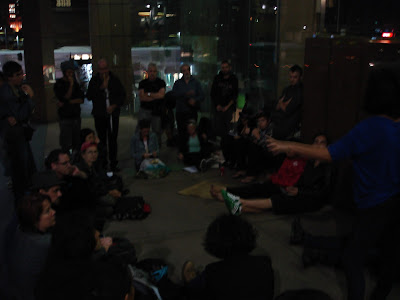
So for the first time since I got back to Australia, I made time to head down to Occupy Sydney for the General Assembly tonight. Overall I found it quite an enthusing experience and a really inspiring movement to be a part of, despite the fact that I missed out on the height of mobilisations while I was in Palestine (something which people at the GA told me not to feel guilty for!) and also despite the particular personal politics that develop in movement groups like this.

Occupy Sydney General Assembly, 08/02
After a bit of debate about the future direction of the Occupy movement through websites and previous meetings, tonight's General Assembly included an item for open discussion with a mind towards setting some more concrete proposals for future actions in stone at a future meeting in 1 or 2 weeks. Some people argued in favour of maintaining the overnight occupation site as a permanent 24/7 situation, some argued against it. Personally I think there is a bit of a false division between some different visions of Occupy; the question to me is how the movement continues to grow. The fact that the police are constantly harrassing this movement would be bound to generate public sympathy if the police weren't managing the mainstream media narrative; when it's not so late and I've got some more time, and perhaps a chance to interview some of the people involved in the legal action (rather overworked given the number of cases running out of the movement!), I plan to write up a much more detailed account of the police's attacks on this movement. However, at the same time I think it's real to acknowledge that it's draining resources to maintain a constant legal war of attrition with the cops. It's important that our time as people who want to change the world and don't have the convenience of money and power to do it with focus our energy as much as possible on the strategic goals. To me, actions, events and campaigns which will involve more people and potentially reclaim a mass audience for the movement are exciting, especially given we're at a time when Australia's workers are being made to start paying for the global crisis (even though it "hasn't hit us" yet...). But the Martin Place campsite can play a part in that too.

Occupy Sydney General Assembly, while falling governments tick by overhead...
Some great sounding plans for ramping up campaigning for the year were floated around, so I don't think we've heard the last from this movement, no matter what the police do to try and wear the campers down or drain the scant resources we have.

Police pull over a motorist in the background of the #OSyd campsite...
I still don't think I'll be camping out just yet... but who knows :p

Sunday, 5 February 2012

Free Free Syria

I attended a anti-Assad Free Syria rally in Sydney today, which drew around 3-500 demonstrators to Hyde Park. Check out some crappy phone photos here.


Tom looking shady... 


Opponents of military intervention, many of whom support Assad for being a thorn in Israel's side, Syria's role in the "anti-imperialist" diplomatic bloc headed by Venezuela, or both, have been sharing this article by Pepe Escobar "exposing the Arab agenda in Syria". While I'd certainly agree with his analysis of the role the GCC & NATO are playing with regards to Syria and the Arab Spring as a whole, a lot of what he writes is pure speculation, such as:


"The Syrian National Council is essentially a Muslim Brotherhood outfit affiliated with both the House of Saud and Qatar - with an uneasy Israel quietly supporting it in the background. Legitimacy is not exactly its cup of green tea. As for the Free Syrian Army, it does have its defectors, and well-meaning opponents of the Assad regime, but most of all is infested with these foreign mercenaries weaponized by the GCC, especially Salafist gangs."

What the observer mission's report that Escobar quotes from has evidenced is that some parts of the civilian uprising have turned to armed violence. However, I've seen compelling arguments (from the BBC and other corporate media outlets, but also from activists) that many of these "shady gangs" are government-backed shabiha, like the baltageya in Egypt, committing acts of terrorism to intimidate the population while allowing the official armed forces to distance themselves. 


As western observers and commentators I think we need to see some actual evidence as to the leadership, intention or composition of these armed forces before we start prosthelytizing against them. Many stating that the Syrian resistance is all "salafist" or "brotherhood" or "western backed" are the same people who have written off Libya's democracy movement as a CIA plot because of atrocities committed by some armed groups or the composition of the NTC, ignoring the fact that there are significant ongoing protests against the NTC by those who rose up against Gadaffi, especially in still-impoverished Benghazi. Why these people decided to protest now if their original protests were simply a CIA plot is anyone's guess...

However, I do think that we can clearly say that the Syrian government is imprisoning and torturing dissidents, as it has for decades, and that we support the Syrian people's struggle for real democracy and against Assad. Just because he's an "enemy" of Israel or the US doesn't mean Assad isn't a ruthless unelected dictator. Even though there are opinion pieces in the Jerusalem Post calling for Assad's overthrow and dismissing the observer mission as a failure because it was "
directed by the Syrian authorities to visit and report about places and incidents of the government’s own choice" (hardly true, given they travelled to several locations without a government escort) still doesn't mean he isn't a ruthless unelected dictator or the uprising against his rule shouldn't have our support and solidarity.

The report itself documents violence against civilians by the military, the military by armed groups, and widespread suggestions that much of the armed groups are fighting back after 10 months of government crackdowns.


"On being assigned to their zones and starting work, the observers witnessed acts of violence perpetrated by Government forces and an exchange of gunfire with armed elements in Homs and Hama."
...
"The Mission visited the residential districts of Baba Amr, Karam Al-Zaytun, Al-Khalidiyya and Al-Ghuta without guards. It met with a number of opposition citizens who described the state of fear, blockade and acts of violence to which they had been subjected by Government forces."
...
And perhaps most importantly:
"The Mission has received requests from opposition supporters in Homs and Deraa that it should stay on-site and not leave, something that may be attributable to fear of attack after the Mission’s departure."
- now, 5 days after the mission has withdrawn, there's been widespread reports of the arrest, torture and murder of civilians, which is where today's protests in Sydney, across Australia and the world fit in.

There's certainly armed groups who are committing acts of violence against the military, the state and civilians. There's also certainly peaceful protest and opposition to Assad's regime, and Assad is also certainly attempting to crush and repress it. The report has shown that the escalating situation of violence is the result of that repression.

Supporters of the struggles for freedom in the MENA region over the last year should above all reject all attempts to restrict or limit the gains that these revolutionary movements can win; whether that's the attempts to repress them by the dictators; directing the movements off the streets, out of the workplaces and into parliaments; foreign military intervention, which might save lives (or might kill more) but will inevitably make it harder for revolutionary movements to keep challenging the status quo once the dictator is gone, or limiting opposition to the regime into a dualistic narrative of pro-west/anti-west, islamist/secularist or whatever. Good people who oppose global imperialism who would otherwise support the resistance of a people to their oppressors are coming out to lie about, obfuscate about or straight up pretend away movements for change because they don't fit their conceptions of imperialism and the regional political balance, which is just what the forces of global capitalism want to see happen out of any interventions.

Finally, in Australia's "free democracy" itself, the corporate media is showing its colours just as clearly as ever, getting this article up on the "attack" on the Syrian Embassy in Canberra while as of yet not posting a single shot of the protest marches calling for Assad to go in Sydney or Melbourne.

Monday, 30 January 2012

Interview with Palestinian People's Party

In November 2011 I spoke with Hannah Ameera, member of the executive committee of the Palestinian Liberation Organisation (PLO) and leader of the Palestinian People's Party, in Ramallah.

Patrick Harrison: Why did you decide to change the name from the Communist Party to the Palestinian People's Party?

Hanna Ameera: Historically speaking the communist movement in Palestine originated in the Palestinian Communist Party. It was established in 1924 as a a Palestinian-Jewish party. This was until 1943 when the Palestinian communists formed the National Liberation League in 1943 as a kind of split from the PCP. In 1947 there was the UN Partition Plan; the PCP & the League both accepted the partition plan but the Arab states and the conventional Palestinian movement at that time rejected it. Then came the war of 1948; the Palestinian communists at that time became refugees as did other Palestinians. In 1948 they formed the Israeli Communist Party, Palestinians & Jews in Israel. And in 1951 the Palestinians in the West Bank formed the Jordanian Communist Party along with Jordanian communists. This was the situation until the war of June 1967 when Israel occupied the West Bank & Gaza Strip, and then began the rise up of the national movement at that time. So the Palestinians in the West Bank & Gaza Strip in 1978 formed the so-called Palestinian Communist Organisation which was an independant entity but it was a part of the JCP until 1982 when we formed the Palestinian Communist Party.

In 1991, after the fall of the communist states, we realised that we are still in a liberation movement and for now all the classes should unite in one struggle against the occupation; we realised that we should make certain changes, in the program and in the name, in order to stress the democratic identity of the party on the internal level. Underneath that was the rationale that this party should be more popular and more close to the mentality of the people. In all the Arab world communism has been associated with atheism because of the imperialist propaganda about communism; in a conservative society this is not an ideal basis for a mass party. So we decided to make these changes for internal & external reasons – not only because of the fall of the soviet union but because of our internal needs as well. This was 1991 and since then we have kept this name, the PPP, but according to the political program we are the same, and we consider ourselves the inheritents of the communist movement in Palestine - we still a marxist party and part of the communist movement globally, etc.

Patrick: Do you have relationships with leftist parties in Israel?

Hanna: We are in very close relationship with the Israeli Communist Party – we consider ourselves as sister parties. We are in close co-ordination and relationship with them. We organise a lot of joint work – common demonstrations, meetings, on all levels – on the workers level, on the political level, exchange visits all the time, participating in festival & conferences – we are co-operating in a very friendly and close way.

Patrick: Do you think the UN Statehood bid will have any real impact on the situation in Palestine?

Hanna: Of course, it has a very big impact. First of all, it is the only way now to enhance the Palestinian demand for an independant Palestinian state on the borders of 1967, after the failure of the negotiations which were running for two decades. Second, we don't think that the current Palestinian bid should be measured through the criteria of 'is it going to make a state or not' – we just say that, first of all, it is a political way on the international level to implement the international resolutions, second, it will put the Palestinian people closer to their aim of an independant state, third it would push the rest of the international community to intervene, not only the United States – now the US monopolises the mediating role; it has been a big failure and it's time to look for another political way to reach our goals. For that, we think the bid is a new political path and we should go on this path until the end and go into the UN not only as a one-month stand but a process which should lead the Palestinians to their goals. But it's not alone, not separated from the national popular resistance in the occupied territories, and it's not also separated from the support of the Arab world & international community. It's a whole process of multiple actions.

Patrick: How important do you see the national popular resistance as, such as the demonstrations against the wall or the Freedom Riders actions?

Hanna: We should all the time express our opposition to the occupation. All the time. There should be new initiatives, there should be mobilising of the people all the time, in this direction. Not only demonstrations and actions like that but also the boycotts of the Israeli products – we have a very wide range of goals in popular resistance & the people here feel that they have the power to do it – not to wait as it was before. Before, we were waiting for the Arab states to liberate Palestine; after that, we were waiting for the Palestinian armed resistance to liberate Palestine, and now the people feel that they should liberate Palestine themselves. This is the main theme of the popular resistance. It means that all the people should take part in this struggle.

Patrick: Do you think the boycott movement is having success in isolating the Israeli ruling class?

Hanna: I think so – but not as we had expected. It's moving, slowly, but forward. This boycott campaign should be both Palestinian and international. At the end of the day it is related to the political positions of the government and the Palestinians themselves. The main thing is the European-Israeli relations. The Europeans, although they have certain agreements with Israel that prohibited exporting settlement products to Europe, do not actually implementing their agreements. They just close their eyes for all the Israeli products which are exported to Europe. At least we should demand the European governments keep their agreements with Israel which they have signed. Second, concerning the Palestinian boycott on Israeli products, it is a complicated subject. Here there is a formal position by the PNA to boycott the products of the settlements (not all Israeli products). But even this position is not implemented 100%, because of our hard conditions in the Occupied Territories. If we have to look in the whole picture, the products and goods from Israel we are importing are worth about 4 billion dollars a year. We are exporting 300 million a year. There is a big deficit and in order to be able to boycott completely the Israeli products we should have production, have industry in Palestine – and this cannot be fully developed under occupation. It's an interaction between the political process and the boycott & popular struggle. But as I said, the main idea behind this boycott is that the Israeli occupation should not be a deluxe occupation; right now, the Palestinians are financing the occupation. It should not be this way, this equation needs to be converted so the Israelis understand they have to pay a price for the occupation.

Patrick: On the movement towards a state – do you feel given the failure of the Oslo process that a two-state solution is viable?

Hanna: Yes, I think so. I think that until now the Palestinian people are choosing the segregation choice – in a choice between having self-determination through unity with others or to segregate yourself from them. Until now we have had this dependant state on the West Bank and Gaza strip, this has been the choice until now. I think that the one-state solution is not a practical one. It's more difficult that the other option because of the refugee problem. Now Israel considers the biggest threat to its identity the five million Palestinians who want to come back to their homeland, if it would be a democratic state then it could no longer remain a Jewish state. The balance of power does not permit for us to make such a solution so we think that it's easier for the Palestinian people to struggle for a Palestinian state in the West Bank and the Gaza strip and afterwards we will see - maybe afterwards there will be this unity, but between two states. For now I think we should stress on the right of self-determination, that this should be expressed through an independant state in the West Bank and the Gaza Strip.

Patrick: And what about the refugee question then?

Hanna: It will be the next stage, after establishing the Palestinian state there should be another kind of balance of power for implementing the other part of self-determination, being the right of return for the refugees. By being in a Palestinian state we will be stronger in our struggle to go forward on this issue.

Patrick: Do you feel that an independant Palestinian state in the West Bank & Gaza Strip will be able to truly democratic state if it can't represent Palestinians inside the 1948 borders of Israel, for example?

Hanna: I think that it should be a democratic state. If there is one thing which is positive in the Israeli occupation in one way or another, it is that Israel is a democratic state – but not for all of its citizens, a democratic state for the Jews only. But being democratic makes you stronger, and a democratic Palestinian state in the West Bank and Gaza strip would be stronger than an autocratic state or dictatorship. I don't think that when the Palestinians are struggling to exercise their democracy under occupation, they will stop trying it when they are independant – mainly after what we've seen going on in the Arab world, this state could only be democratic, it should defend social justice for the workers, journalistic freedom, respecting minorities, etc.

Patrick: In comparasin with the other states – what about political Islam? Islamist movements have won electoral victories through the Arab Spring – is that what brought Hamas to power, and are we likely to see a repeat of it?

Hanna: Political Islam should be experienced by the people for a certain stage. The people should discover through their experience that the so-called "Islam as a solution" is not workable and this will pave the way for a more democratic society, a more progressive society. Some people here think that the heritage of the past will solve the problem of the day – there are certain people who think like that – they should discover by their experience that this is not the solution. Besides that the communist & left parties should strengthen their position & be more popular here because what happened in the Arab World indicates that tyranny will not sustain itself for a long time. Even if it was supported or concealed by certain ideologies like Islam, tyranny still isn't sustainable. We should look into the future more openly, maybe on the direct developments around us in the Arab world will be not so great for the progressive and left movements but in the long run it will be much better.

There has been a growth in democratic consciousness here in Palestine. Nothing that Hamas has done has led us in the right direction. I don't think we're likely to see Hamas elected to another parliamentary majority here. In Tunisia, after the elections, people have already began to think – what have we done? Ok, we were oppressed, we suffered for a long time by the previous regime – but what have we done? I think that people should go through this experience. It's not enough to try to teach them or to preach at them, this is not enough – they must experience it themselves. After that they will discover that this way will not to the goals that they want. Thomas Edison failed more than 1,000 times when trying to create the light bulb. When asked about it, Edison said, "I have not failed 1,000 times. I have successfully discovered 1,000 ways to NOT make a light bulb." So people will in this way progress towards real change.