Showing posts with label police. Show all posts

Thursday, 23 May 2013

ASIO Harassment

Originally published by Green Left Weekly

On Tuesday the 16th of April, I received a knock on the door from two members of the Australian Security Intelligence Organisation, better known as ASIO.

The two told me they would like to have a conversation. When I asked what they wanted to speak about, they told me they were doing their job - protecting national security – and had a few questions about my involvement in activism in Sydney.

Apparently the latest threat to national security is “political violence” in the activist community. As a Palestine solidarity activist involved in organising the Sydney rally to commemorate Nakba (the catastrophe, when the state of Israel was created and Palestinians dispossessed) the agents wanted to speak to me about any concerns I might have, or for me to identify any individuals who I was worried might be responsible for acts of political violence.

I replied that the only fears of violence that I had from my involvement in Palestine solidarity activism were from the far right groups and individuals who often organise counter mobilisations – or simply send threatening and intimidatory emails, messages and phone calls in an attempt to stop or derail our protests and other events.

I was also questioned by the employees about the recent rally against police violence at Mardi Gras – which I didn’t attend – and the picket lines at the University of Sydney, where I study, organised by the National Tertiary Education Union. Once again, my answer was that the only violence I have seen in my time as an activist has been initiated by those seeking to silence our right to protest. 
 
In the case of Sydney University, this comes from members of the “Public Order and Riot” Squad of the NSW Police force, who have been sentin to break up the picket and other protests to defend education and student rights. At the latest picket, they were responsible for breaking one student's leg and another's ribs.

Other people in Sydney and Melbourne involved in campaign groups have also been approached by ASIO and asked not to speak about these visits.

In a context of the “war on terror” overseas — which has involved Australian troops involved in wars in Iraq and Afghanistan for the past decade — there is a war on civil liberties at home.


ASIO’s mandate is broad and without scrutiny. The organisation is responsible for providing security assessment for refugees seeking asylum in Australia, with no public oversight. Tamil asylum seeker Ranjini and her two sons are locked up in Sydney’s Villawood Detention Centre because ASIO decided she is a “security risk”.
 
Security organisations have had their powers expanded and budgets increased by Labor and Coalition governments, and consequently have increased their monitoring of Australians.


As $900 million is being slashed from our universities through an “efficiency dividend”, the new ASIO headquarter building in Canberra is facing yet another costly delay in opening. After being estimated to cost $460 million when construction began under the Howard government, the full price tag is now being estimated at over$631 million dollars – over 2/3 of the university cuts.

Construction has had no parliamentary oversight, and there was no public consultation.

The Australian Security Intelligence Organisation Act 1979 (the ASIO Act) even makes it illegal to publish the identity of any officer, agent or employee of the organisation. 

Last year, Green Left Weekly reported on activists involved in pro-Palestine and pro-Tamil solidarity campaigns in Adelaide who had also been visited by South Australian Police working in “security and intelligence”.

These visits are an attempt to intimidate people into ending their involvement in legitimate political organisations. Organising and attending demonstrations is not illegal and people involved in these activities should not be monitored by ASIO.

There is no law that prevents people from speaking publicly about a visit from ASIO. Shining a light on these practices is important to show that we will not be intimidated into exercising our democratic right to protest.


If the powers that be were serious about national security, they might abolish this spy agency - and withdraw our troops from the costly and unjustifiable occupation of Afghanistan - instead of harassing activists who are only exercising their democratic right to protest.

Sunday, 23 September 2012

September 20 Rally for BDS - Sydney

Photos by Kate Ausburn, http://www.flickr.com/photos/treslola/sets/72157631580808970/with/8005982335/

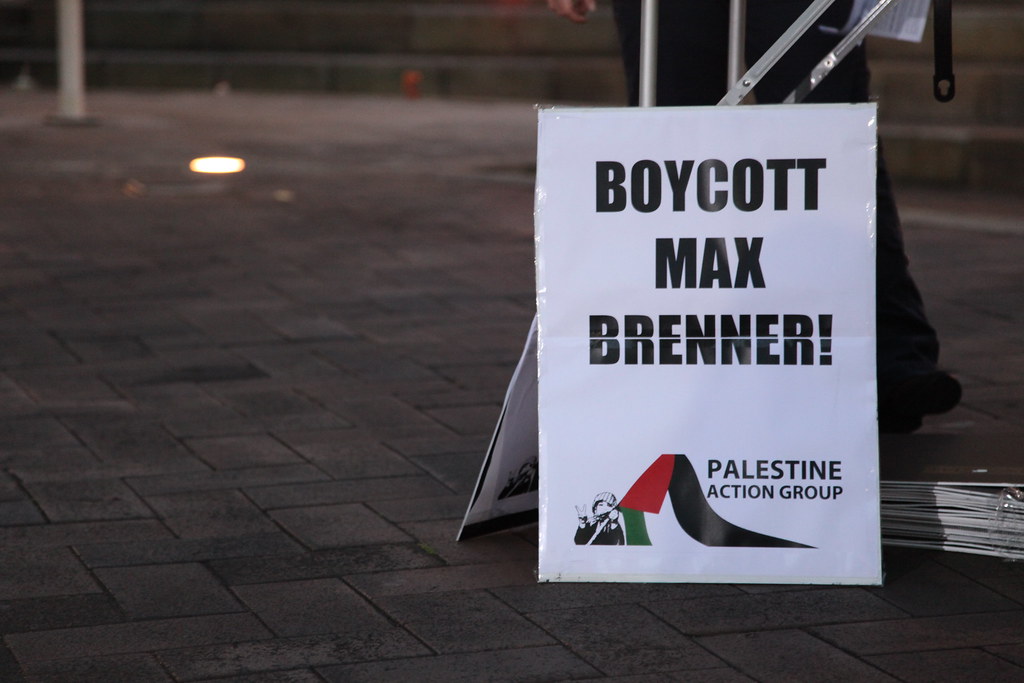
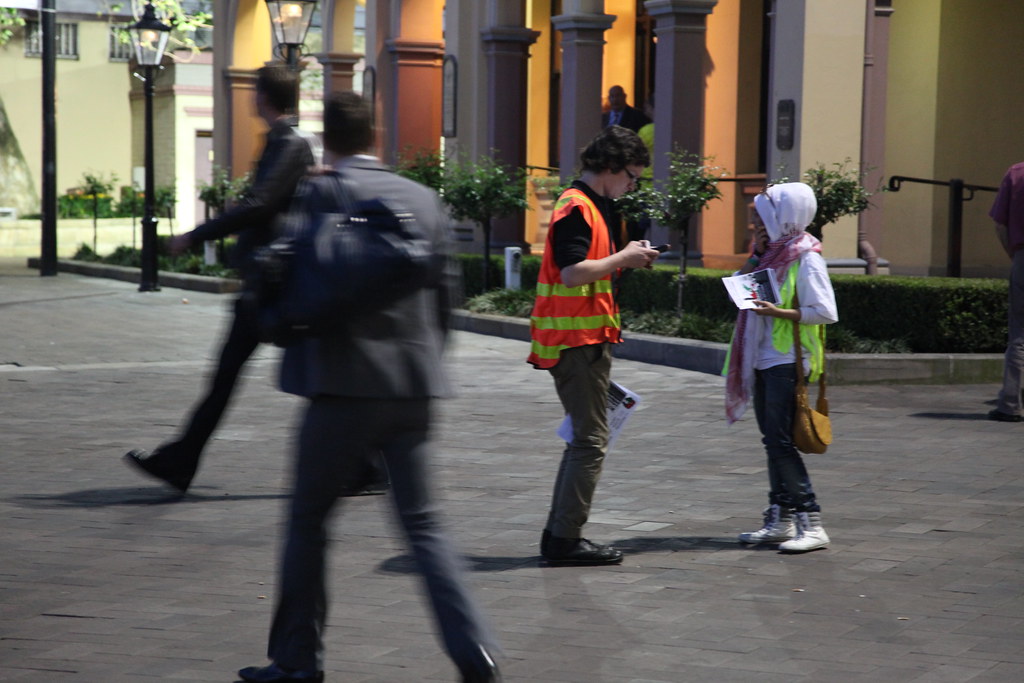
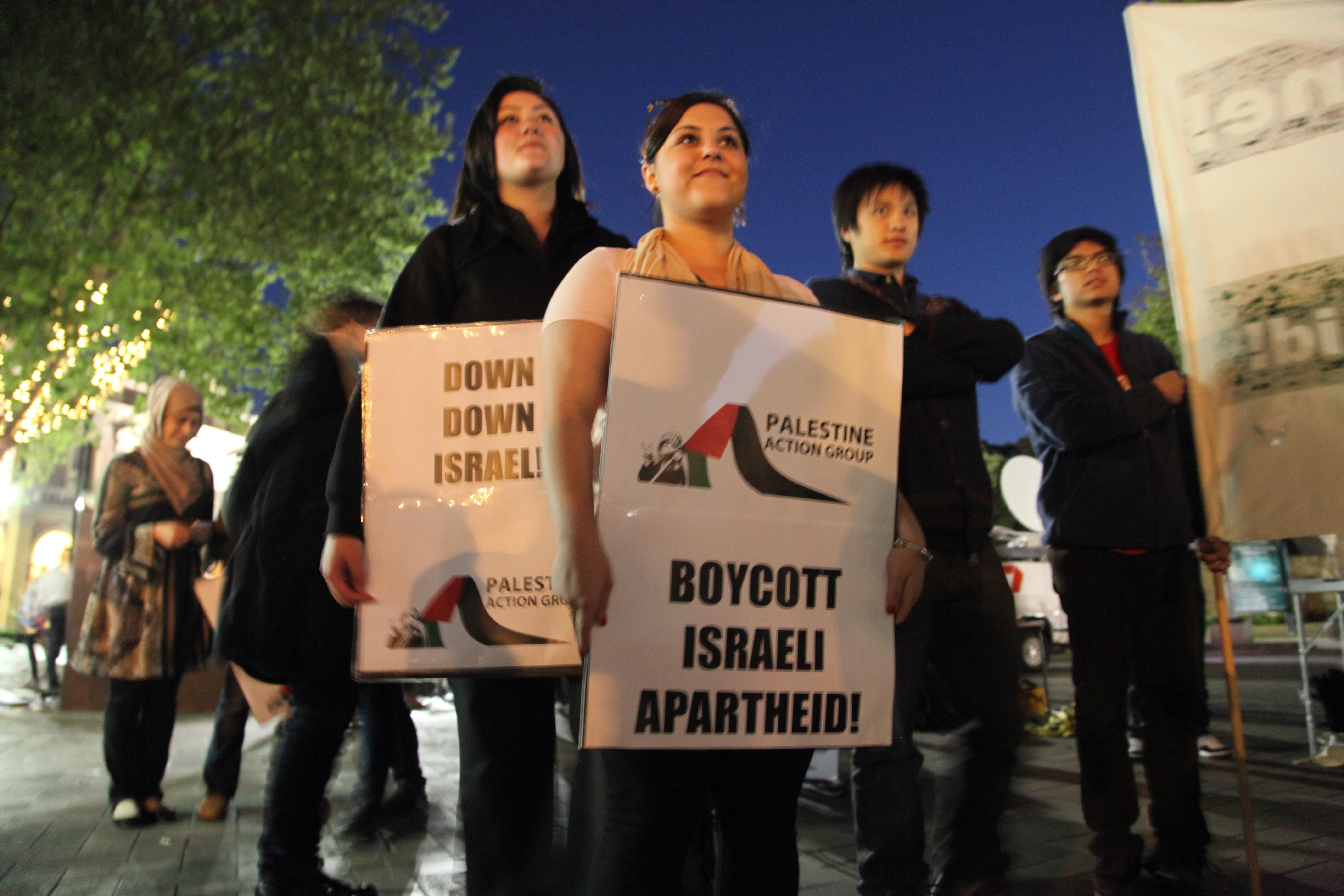
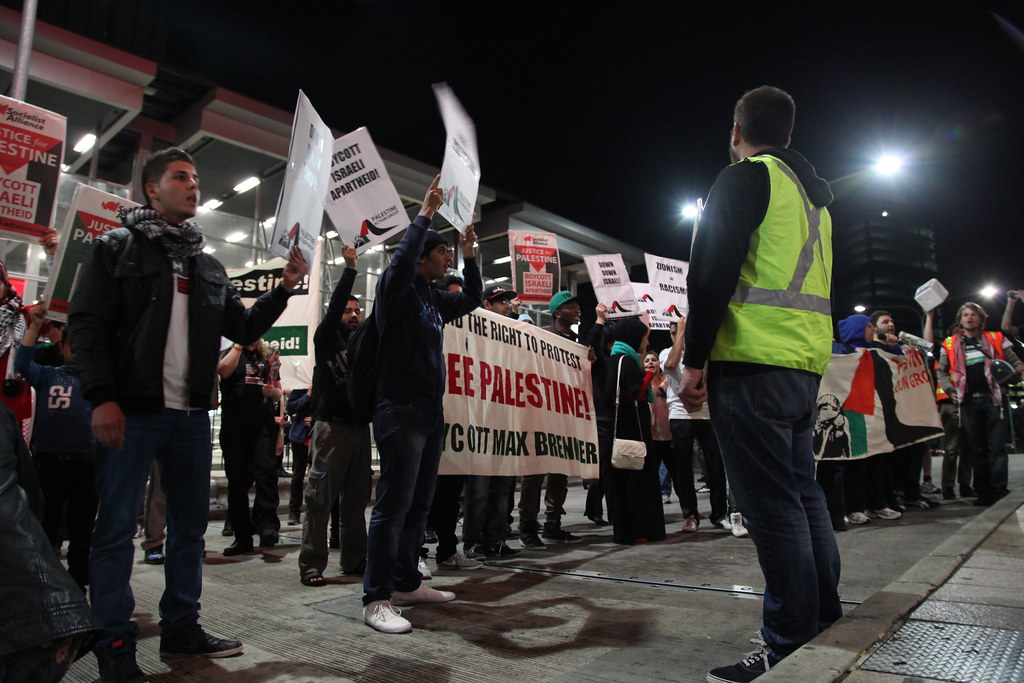
Around 100-150 attended a September 20 rally and march at Max Brenner in Sydney's western suburb of Parramatta, organised by the Palestine Action Group, which I chaired.  The rally was in support of the global campaign of boycotts, divestment and sanctions against Israeli apartheid today. The protest was timed to also commemorate the massacres at the Sabra and Shatilla Palestinian refugee camps in Lebanon 30 years ago; the Golani Brigade, which Max Brenner's parent company, the Strauss group, donates care packages to, was involved in those massacres.


Photos by Kate Ausburn, http://www.flickr.com/photos/treslola/sets/72157631580808970/with/8005982335/

After the Muslim protests last weekend organisers were called in by the police and asked to call off the protest; after stating they didn't feel comfortable doing that, the police stated they would come to an agreement acceptable to both parties, while at the same time informing the organisers they had a high court summons for later that night if one couldn't be reached. However, the police do seemed to have learned from the last time they tried to take us to court for the Nakba day demonstration and it backfired; this time, they agreed to allow us the full use of the road for the alloted time, and to keep the riot police back so long as we marshalled the protest effectively. It all went really smoothly, we outnumbered the far-right pro-Israel mob drinking chocolate around 10-1 (as usual), and it was a really pumping experience!

Photos by Kate Ausburn, http://www.flickr.com/photos/treslola/sets/72157631580808970/with/8005982335/

Given the climate and the fact that shock jocks seized on our protest as a "follow up" to the weekend, there was a huge media presence. Of course this wasn't framed in the best way (and they took one of my less sharp moments to quote from, of course), but we got a bit of media from Channel 9. On the night I'm pretty sure 7 gave us a live cross to the news program, and PressTV and ABC Radio definitely got interviews too, although I haven't seen/heard them surface yet.


We also got quite a decent write up beforehand in Sydney's City News, quoting myself from PAG, Haskell from Jews Against the Occupation Sydney, Rachel Evans from Socialist Alliance and a Murdoch Uni academic I don't know. After the interview I assumed they would play the "tapping into Muslim anger" angle (a lot of questions went in this direction) but they actually wrote something extremely favourable, running my quotes regarding Israel's colonial and apartheid occupation of Palestine. W00T!


Photos by Kate Ausburn, http://www.flickr.com/photos/treslola/sets/72157631580808970/with/8005982335/

I'm quite happy with the good work for BDS happening here in Sydney, even with all the Islamaphobia being heaped around we still managed to make a very good, peaceful and vibrant mobilisation, and we're in a great position to keep building this campaign and put some runs on the board in the fight against Israeli apartheid :) I'd like to commend everyone involved in this campaign sofar - Palestinian students, independant activists, socialists from different organisations, we've all been working together very collaboratively and have been well recieved to get real traction.

Wednesday, 23 November 2011

Egypt: Massacre of Coptic protesters

The following article was first published at Green Left Weekly on October 16, after the massacre of Coptic protesters the previous week. Given the advances made by the revolution in uniting the struggle against the SCAF since then, the incident was an important turning point.


Regime tries to whip up religion tensions with anti-Copt violence

Sunday, October 16, 2011

Walking around downtown Cairo on October 10, everything felt relatively normal ― if, perhaps, a little more tense than usual for post-January 25 Cairo.

That is, until I came across the wrecks of burnt out cars on the Corniche el Nil in Maspero, just north of Tahrir Square, being pulled apart by enterprising young men.

The night before, Coptic Christians marched from Shubra to protest acts of discrimination against Copts by the interim government, including the destruction of St. George's Church in Aswan and the forceful break-up of a protest on October 5. The marchers were assaulted by unidentified groups of thugs before being massacred by the military.

At least 26 people were killed in the ensuing violence, many by army armoured personnel carriers that drove straight into the crowd of thousands, gunners firing wildly into the night.

But despite the headlines flashing across the world, it is wrong to call this an act of sectarian violence. What happened on the night of October 9 was state violence against peaceful protesters, on a scale not seen since Hosni Mubarak's ouster on February 11.

Eyewitness reports on social media sites such as Twitter claimed that the groups of thugs attacking the protesters grabbed people and dragged them over to army and police forces to be arrested. This suggests that the lion's share of violence was not created by the religious tensions, but the regime's baltageya (political thugs loyal to the interior ministry).

The regime has been busily exploiting religious tensions within Egypt since the fall of Mubarak, trying to split the unity between Christians, Muslims, atheists and other Egyptians shown during the occupations of Tahrir Square.

This includes broadcasts from the state media, which, as protesters were being massacred on October 9, were busily reporting that Christians were stealing weapons from the army and killing Muslim soldiers, the Al Masry Al Youm site said.

Mohamed Abou El-Ghar, of the Egyptian Social Democratic Party, said in a cross-party press conference on October 10 that condemned the violence that the state media had urged Muslims into the street to protect the armed forces. The state media claimed the protesters were burning Qurans in the street.

Yet, despite this campaign, the graffiti around the city showing the Christian cross and the Islamic crescent, with the words "2gether 4ever", has been some of the best preserved since the start of the revolution.

Another rumour repeated to me on the streets of downtown Cairo as the bloodshed was unfolding was that the protesters were marching to support Mubarak.

No doubt seeking to bolster their own support base and fan the flames of religious tension, the Muslim Brotherhood released a statement calling on Copts to cease protesting for the sake of "democracy".

“There are certain channels, means and times for demanding legitimate demands and all Egyptian people have legitimate demands, not only our Coptic brothers,” said the statement. “This is certainly not the right time to demand them since the current government is an interim government and the general conditions are abnormal."

The Brotherhood demanded the regime keep the current timetable for elections.

The Revolutionary Socialists, on the other hand, condemned the oppression of Copts "which goes hand-in-hand with a policy of divide and rule between Christian and Muslim working people".

"We will continue to defend our revolution, and the people’s right to free expression, to protest, demonstrate and strike, in order to restore our stolen rights, and to cleanse the country of the roots of corruption, which is still poisoning our revolution and attempting to overturn it," their statement read.

Coptic protests continued on October 10, with mourners rallying outside the Coptic hotel in the Cairo suburb of Ramsis. They chanted against the Supreme Council of Armed Forces (SCAF), Egypt's power behind the throne since Mubarak's downfall, before marching to the State TV building in Maspero.

Reports from Al Masry Al Youm said up to 20,000 took part in the march.

Despite a huge police and army presence at Maspero earlier in the day, which looked like it was gearing up to block the protests, there was no massacre this time. Local residents showed support for the protesters, and some threw bottles of water to the marchers.

The interim government has responded to the violence and international condemnation by launching a quick inquiry, detaining 25 suspects implicated in the violence. It added the “Equality Law” to the penal code, which stipulates special punishment for anyone who carries out any action that causes violence against individuals or communities based on gender, race, language or religion, or which might lead to unequal opportunity or social inequality, reports from State TV said.

But in Egypt's current climate of lax police enforcement, and the open unity of the army and police in repressing the protests (a change in tactics from the days of the uprising against Mubarak), perhaps the only real change to Egypt's political landscape after October 9 will be a growing awareness that the SCAF, despite its rhetoric, is doing everything in its power to hold back the revolution.

Monday, 7 November 2011

Tunisia: First Thoughts + Photos

Ash-shaʻb yurīd isqāṭ an-niẓām

Place du Governement... still a police state.

After the turmoil of Cairo, with ongoing mass protests and the general hubbub of one of the regi on's capitals, Tunis was both a relief and a shock. The more laid-back atmosphere of Tunis reminds me of Australia (I found myself saying "she'll be right" every five minutes) but arriving around a month before the Constituent Assembly elections meant that the interim government was pulling out all the stops in stopping public spaces from being used in unsanctioned ways. I have to admit that I did find myself despairing a little bit to be seeing such a blatant exercise of police state power in the nation where the Arab Spring began - but I quickly realised that Tunisia's revolutionary struggle, like Egypt's, has only just begun.

This is Avenue Habib Bourguiba, where the protests which toppled Zine el Abidine Ben Ali were centred.. in September & October it was under total lockdown, police & military trucks full of reinforcements & barbed wire emplacements at either end. Since Ben Ali's downfall, the Kasbah (a beautiful tiled square across the road from the Place du Government, above) has been the usual place for mass assemblies; every time I went there to lie in the sun and listen to my iPod, there was at least one truck full of police &or soldiers lounging about. Perhaps that's why nobody bothered me! Tunis is definitely nowhere near as overcrowded as Cairo, but it's a bustling cosmopolitan city - a great place to spend my birthday :)


Unemployed secondary teachers staging a sit-in outside of the Ministry of Education - when I spoke to them they had been there daily for over one month, although the police had turfed them from the footpath & fortified it after a few weeks. They represented Tunisia's situation in many ways - feeling like the political process of interim governments and Constituent Assembly had little ability to deliver the reforms they were asking for, which were just jobs. They had all completed their education but had nowhere to work; the interim Prime Minister had told them verbally but refused to give it in writnig that they would get jobs by January (by which time the new government appointed by the Consitutent Assembly will be in power).


Activists from Italy & Tunisia meet at La Goulette port to raise awareness for the Tunisian & Libyan refugees being detained on Lampedusa. Marine Le Pen, who appears to be a far more articulate French version of Pauline Hanson to Sarkozy's John Howard, travelled to the island after the revolutions to tell the Italian navy to "turn the boats around" and "take them back where they came from". Australia is 10 years ahead of the curve when it comes to racist rhetoric, woo! */sarcasm* Pictures is Azyz Amami, one of Tunisia's blogger crew who along with Slim Amamou was arrested and tortured during the uprising against Ben Ali.


Graffiti on Avenue de France - "How much better is Tunisia without Ben Ali Baabar & the 40 thieves"


Some things need no translation... Although for those not familiar with Tunisia, the Trabelsi family were one of those who profited from Ben Ali's rule; they fled the country when the Revolution started. The UJCT (Union of Communist Youth of Tunisia) is the youth wing of the Tunisian Worker's Communist Party (PCOT from the French, or "poct" in common language...). Poct were, along with the Tunisian bloggers, democracy activists & others, one of the forces which were most central to the success of the uprising against Ben Ali - especially due to their somewhat clandestine involvement in the trade unions, whose leaders were collaborators with Ben Ali but which still were relatively safe places for leftists at the branch levels.